freebetty

bird behaviour

bird behaviour

Vicky's sitting on her nest

Vicky greets us when we pay a visitYesterday Gitie and I went to see how Vicky and Bertie are doing this year on the nesting front. Although Vicky's nest is in line with our breakfast room, it is distant and we have not been able to set up the telescope this year. So imagine our delight when we found Vicky sitting proudly on the nest. The nest is in a tricky spot, so Gitie stayed by the road while I went through the paddock to the nesting tree. This is the tree that Vicky and Maggie purchased from a crow some years ago, giving the crow their old tree and nest in return, as well as rights to get food from their human friends (us) for a year). The crow made Vicky's old nest bigger and stronger, while Vicky lined the crow's nest with lots of soft material. read more »

The Magpie Winter Season

Our birds have had a strange winter to deal with: overcast most days instead of sunny, cold days, but some warmer nights as the clouds keep the heat in.

Our magpie family, Vicky (the queen), Bertie (her consort - alpha male but her subordinate!), Vicky's adult daughter Mindy and youthful daughter Kenny, have fared well, but with a fly in the ointment: Mindy's twin brother Monty was told to leave when Bertie moved in, but he has gone across the gully and formed a group with three others. One is a daughter (Louie) of our other magpie family, Billy and Polly, but two more seem to be newcomers. We were feeding Monty when he was alone, but since his foursome has been formed, they think they can muscle in on the breeding pair's feeding ground - which is against magpie rules, of course, but his own mother is not keen on sending him packing, and so Bertie and Mindy have to do all the work of repelling Monty's gang, which is proving tough for Bertie. Luckily Bertie is an amazingly strong bird, but we have had to add our support to his side of the dispute and tell Monty we can't feed his gang any more. read more »

Fiona's Peewees Help a Turtle

peeweesFiona loves Peewees and has a favourite Peewee family living in her yard (see slideshow below).  Also called mudlarks, the birds are friendly and get along well with her gorgeous hens (Lucy and Gertrude –Columbian Wyandottes, and Edna - silver-laced Wyandotte), but Fiona was yet to discover how amazing these birds can be. read more »

Synchronised Curries at The Lilypot

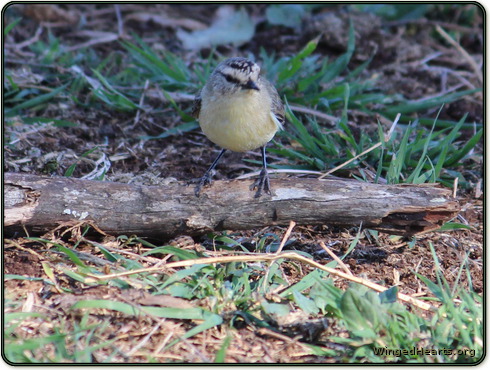
Synchronised swimmers in disguise?   Almost....  It's Karivon and Karitu the Currawong twins having a drink at the lilypot. 


(click on the 'next' button to flip through the slides ).
Previous Slide 1/4 Next

  read more »

What is Your Bird Story? Share It On WingedHearts.org

wille-wagtail sitting on the fence The 30 day blog challenge is over for those of us who live down under in Australia.  It's already 1 hour into the 1st July (yes I am so addicted to writing for you that I'm still up at 1.00 am.)

Thank you all so much for your interest and comments.  I really appreciate all of you who made the time to read my stories and give me your feedback.  I've had a wonderful experience sharing a little of what I have learned from these remarkable creatures with all of you.

We have so much more to learn and this can only be achieved if we share our stories and learn from examples.

I believe we all have an amazing bird story hidden in our memories. 

What is Your Bird Story?

It's time to tell all the rest of us. read more »

Wild Birds Love 'The Big Eye'

female cuckooThe first time a bird sees a camera, he/she may feel a bit unsure of the big thing we place next to our eyes that also makes a clicking sound.  But in no time at all, they realise that the sound poses no danger to them. Once they become comfortable with the sound, they feel quite amused by our fondness for pointing this object towards them.

We use a Cannon S5 with a 1.5 teleconverter lens which is a reasonable sized equipment. To the bird it looks like we have added a big round black giant sized eye to our eye.

The birds have no idea what the camera really does for us, but that doesn't stop them from appreciating many things about it, in their classic style of observing our actions. read more »

Listen With Your Eyes

scaly-breasted lorikeet In order to understand birds, one has to pay attention with both ones ears and eyes.  In other words we need to hear  the sounds they are making while also following their actions. I call this 'Listening With Your Eyes'.

Birds love chattering and sharing the days news with each other.  Every bird species has its own language. The different species don't have much difficulty following each other.  The birds also have a range of soft almost inaudible 'mm', 'bb' type sounds and a lot of their communication is also non-verbal. read more »

Wild Birds Show and Tell to Communicate With Their Human Friends

Juvi Wendy magpie with Mum Vicky magpie Today I'm going to show you some examples of the way birds use 'show and tell' as a way of communicating with us (and also each other).

Consider the following two cases:

1.    A group of magpies flies overhead headed towards the north.  Our magpies sing out to them as they fly over. After a few chords they continue doing whatever activities had occupied them before. read more »

7 Tips to Get To Know Your Wild Birds - Part 2


This is one of the first pictures I took of our birds back in 2001 with a film camera. (Any one remember those things that had to be handled carefully and in the dark?)

Molly magpie teaching Maggie magpie and Cindy magpie to sing

Here sitting on an old gum tree is Molly the mother magpie teaching juvis Maggie and Cindy to sing.  They had the most brilliant voices and loved singing at top volume.  This was during my early days of friendship with them. 

In today's post we will explore tips 4-7 of getting to know your wild birds. read more »

7 Tips to Get To Know Your Wild Birds - Part 1

Vicky magpie with visiting rainbow lorikeets  By now you will have a few friends whom you recognise and call by name. The next stage is to get o know more about your birds. 

There are seven main points that you can follow to further develop your relationship with your new wild bird friends.  These are:

1. Make Time For Regular Interaction

2. Learn More About The Species

3. Gain Insight's Into Your Individual Bird Friends

4. Listen for Cues

5. Notice Changes In their Behaviour

6. Keep a Daily Journal

7. Look for Wider Patterns and Stories read more »

Theme provided by Danetsoft under GPL license from Danang Probo Sayekti