freebetty

human-bird friendships

human-bird friendships

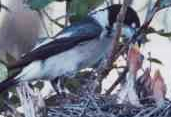
Vicky's sitting on her nest

Vicky greets us when we pay a visitYesterday Gitie and I went to see how Vicky and Bertie are doing this year on the nesting front. Although Vicky's nest is in line with our breakfast room, it is distant and we have not been able to set up the telescope this year. So imagine our delight when we found Vicky sitting proudly on the nest. The nest is in a tricky spot, so Gitie stayed by the road while I went through the paddock to the nesting tree. This is the tree that Vicky and Maggie purchased from a crow some years ago, giving the crow their old tree and nest in return, as well as rights to get food from their human friends (us) for a year). The crow made Vicky's old nest bigger and stronger, while Vicky lined the crow's nest with lots of soft material. read more »

What is Your Bird Story? Share It On WingedHearts.org

wille-wagtail sitting on the fence The 30 day blog challenge is over for those of us who live down under in Australia.  It's already 1 hour into the 1st July (yes I am so addicted to writing for you that I'm still up at 1.00 am.)

Thank you all so much for your interest and comments.  I really appreciate all of you who made the time to read my stories and give me your feedback.  I've had a wonderful experience sharing a little of what I have learned from these remarkable creatures with all of you.

We have so much more to learn and this can only be achieved if we share our stories and learn from examples.

I believe we all have an amazing bird story hidden in our memories. 

What is Your Bird Story?

It's time to tell all the rest of us. read more »

Wild Birds Love 'The Big Eye'

female cuckooThe first time a bird sees a camera, he/she may feel a bit unsure of the big thing we place next to our eyes that also makes a clicking sound.  But in no time at all, they realise that the sound poses no danger to them. Once they become comfortable with the sound, they feel quite amused by our fondness for pointing this object towards them.

We use a Cannon S5 with a 1.5 teleconverter lens which is a reasonable sized equipment. To the bird it looks like we have added a big round black giant sized eye to our eye.

The birds have no idea what the camera really does for us, but that doesn't stop them from appreciating many things about it, in their classic style of observing our actions. read more »

Listen With Your Eyes

scaly-breasted lorikeet In order to understand birds, one has to pay attention with both ones ears and eyes.  In other words we need to hear  the sounds they are making while also following their actions. I call this 'Listening With Your Eyes'.

Birds love chattering and sharing the days news with each other.  Every bird species has its own language. The different species don't have much difficulty following each other.  The birds also have a range of soft almost inaudible 'mm', 'bb' type sounds and a lot of their communication is also non-verbal. read more »

Wild Birds Show and Tell to Communicate With Their Human Friends

Juvi Wendy magpie with Mum Vicky magpie Today I'm going to show you some examples of the way birds use 'show and tell' as a way of communicating with us (and also each other).

Consider the following two cases:

1.    A group of magpies flies overhead headed towards the north.  Our magpies sing out to them as they fly over. After a few chords they continue doing whatever activities had occupied them before. read more »

7 Tips to Get To Know Your Wild Birds - Part 2


This is one of the first pictures I took of our birds back in 2001 with a film camera. (Any one remember those things that had to be handled carefully and in the dark?)

Molly magpie teaching Maggie magpie and Cindy magpie to sing

Here sitting on an old gum tree is Molly the mother magpie teaching juvis Maggie and Cindy to sing.  They had the most brilliant voices and loved singing at top volume.  This was during my early days of friendship with them. 

In today's post we will explore tips 4-7 of getting to know your wild birds. read more »

7 Tips to Get To Know Your Wild Birds - Part 1

Vicky magpie with visiting rainbow lorikeets  By now you will have a few friends whom you recognise and call by name. The next stage is to get o know more about your birds. 

There are seven main points that you can follow to further develop your relationship with your new wild bird friends.  These are:

1. Make Time For Regular Interaction

2. Learn More About The Species

3. Gain Insight's Into Your Individual Bird Friends

4. Listen for Cues

5. Notice Changes In their Behaviour

6. Keep a Daily Journal

7. Look for Wider Patterns and Stories read more »

Building Trust and Friendship with Wild Birds - Part 2

Dimpy-pied butcherbird and Renuthri - noisy-miner basking on the roofNow the birds are getting used to you taking an interest in them. They are beginning to create their own patterns of understanding your words and behaviour, based on the sound and tones of your words and also your actions and movements.

In part 1 yesterday  we covered - 1. Talking to the birds and 2. Watching Their Response.

Every species and every bird in every species will take their own time to respond to you. Some of the bolder birds will start coming forward giving you the opportunity to observe them at close range.

At this point there are a few different things you can start doing. read more »

Wild Birds - Gaining Their Trust and Becoming Friends - Part 1

 There's definitely a list of do's and don'ts when it comes to talking to birds.   butcherbird and rainbow lorikeet making friendsWild birds have a big advantage over us, if they don't like what we're doing or saying they can fly away and avoid our company altogether.  So in this case it is useful to understand the don'ts.  

Birds scare easily - so the very first point is - Take care not to frighten the bird.  This is surprisingly not as obvious as it seems. We humans get excited and enthusiastic and in our eagerness to make friends we sometimes don't give the birds enough time to get to know us.

Friendship is a two-way street and we have give the bird the time and opportunity to observe us as well.  In the beginning, the bird will scare easily.  Their reflexes and inherent instinct is to escape at the very slightest movement in the shadow or flutter of one's sleeve or dress in the wind, or the vibration on the ground when we walk.  This is not due to a direct response to us per se.  But birds are tuned to avoiding danger from other predatory birds, cats and other animals that prey on them.  Even when they know us well, there will be times when they will just fly off and you'll be left wondering what on earth you did to frighten them! Don't be offended when that happens,  and it will happen many times.  

 read more »

Attract Birds To Your Place and keep them Coming - Part 2

bowerbird at the water bathOnce some birds notice your bird bath or water bowl, they'll spread the word very quickly and other birds will also try it out. 

There are a few things you must do to keep them coming:

1. Clean the bird bath and refresh the water daily: if you can, if not, then every second day.  A bristle brush is ideal to scrub the sides, followed by a rinse with fresh water.  This is a necessary step, or else water will get stagnant, even mouldy, certainly filthy and eventually become a source of disease.

if you have placed a big stone or rock in the middle of the bowl to stop it from tipping over, you may find that this will get mouldy over time.  When that happens its best to have a couple of stones, and use them alternately, that gives each one the chance to dry out before being used again.

If the bird bath is not cleaned and refreshed regularly, the birds will stop coming as this will no longer be a viable drinking spot for them.

2. Observe Your Visitors:  Make a note of which birds have started to visit your place.  Are they able to drink comfortably?   read more »

Theme provided by Danetsoft under GPL license from Danang Probo Sayekti