|
Thank you for subscribing to
the Wild
Bird
Talking Ezine.
You may forward this Ezine to
your friends. If you have received this issue from a friend and would
like to
receive your no-cost subscription please click
here.
|
|
 |
|
|
|
Back
to the Top |
|
|
From Maggie's Perch:~
Welcome to
this Edition of Wild Bird Talking
Every season brings new stories and winter this year is no exception. We see two
families of pied butcherbirds negotiating new boundaries with
three families of their close cousins the grey-butcherbirds.
We suspect that our home family of Butch, Cass and their young
are discussing terms with one of their older kids (and one of our
darlings) Teddy-Toms who left home a few years ago, who has set up home in
the neighbouring paddock, and is trying to extend his rights so he can
visit us more frequently. Larry and Harrie's kids in the mean time have also set up home around the valley and want visiting
privileges. Last year, Larry and Harrie being old time
friends of Vicky's had rearranged their agreements which prevented
Larry and Harrie from visiting our yard. Happily they've
included our requests this year and now Larry and Harrie visit the
perimeter more frequently.
Chuckie in the meantime, seems to
have left home still a juvi, while his older siblings Kerry
and Dimpy are still around.
The noisy miners had a late clutch and as soon as the fledglings were
old enough, the groups have done their swap around and we have new
families visiting us for now. The lorikeets
have been socialising with the magpies, while juveniles from
many species have been making their way to join teen groups in the
valley. We were lucky to spot a young
babbler on his way. Can you see the green man in
the slideshow?
Discovering the real identity of an old friend, brought
a new dimension to our appreciation of the incredible depth of
awareness of even the smaller birds, as did the smart lifestyle of a
pair from another vulnerable species, the Rufous
Fantail.
In this issue, we are delighted to bring Sketching tips from one
Australia's finest wildlife artists, Janet Flinn. We continue
our series on communicating with birds, with another
excerpt from Dawn Baumann Brunke's
'Animal
Voices', as
well as more on the art of listening to the birds in Part 2 of Communicating
with Wild Birds.
On June 24 (US which is 25 June in Australian and NZ), we will be bringing you details of two interesting new
releases. The first is a book on "Soul Discovery" by
Joan Marie Whelan
and the second is Alan
Bechtold's book titled "Will Work For Fun -- 3 Simple
Steps for Turning Any Hobby Or Interest Into Cash".
Both books come with many wonderful gifts for buyers, and I
will send you the details of each book in a separate e-mail.
Michael Dalton
has been teaching his macaw to speak English and has released
a book called "Another Kind of Mind: A Talking Bird Master's English"
Look out for the details in the News and Views section below.
This is a good time for readers who live in Australia and New Zealand
to start making friends with the Aussie magpies. Next month, the mother
birds will start laying eggs and four weeks later the birds will
start aggressively protecting their chicks. If you make
friends with the magpies along your walking path or cycling route or
the birds that live near your favourite park, they will think of you as
a friend and are less likely to succumb to their instincts to attack.
You can read more tips in Ron's article on how not to be divebombed by magpies.
We hope you enjoy the selection of articles and
stories and look forward to hearing your stories.
With
Warm Wishes,
From
Maggie
and me,
Gitie

|
|
|
|
|
|
*****
Feature Article *****
|
Back
to the Top |
|
|
|
Sketching Birds
by Janet Flinn
You don't have to be an artist to keep a Sketch Book. A Sketch Book
style Journal helps you keep better records of your birding
observations and adds to your enjoyment of Bird Watching. Start by
sketching the common birds in places where they are used to people.
Don't try for perfection and don't take time to erase. Just jot down
the important concepts. Make short notes around your drawing to clarify
details and to mention any interesting behavior. Notes should include
name of bird, where seen and date seen, colours of plumage, beak and
feet. Notes on behaviour and habitat are useful and interesting to look
back on.
Materials: An A5 sketchbook, soft graphite pencil e.g. 2B. A small field set of Watercolors is useful for making colour notes.
Method: Study the proportions of the bird. Compare the
length of the beak against the length of legs and feet, the size and
position of the eye, the length of the tail against the length of the
wings etc. Draw what you see & don't make anything up. If you can't
see the tail and you add a tail of the wrong length or colour, you will
create a different species.
Sketching Method: Using light 'search' lines draw the basic oval
shapes of head and body. Sketch lightly and quickly. Plot the angle of
body and head, the position and angle of the tail, the position and
tilt of the beak and the position of the eye in relationship to beak.
Use horizontal and vertical check pencil lines. Don't use a rubber yet.
Use a 2B pencil very lightly at first to refine the shape of the bird. Look for the facets
where you think you see curved shapes. Change to a softer pencil or
press more heavily to develop the drawing and add tone. A small piece
of kneadable rubber or a small piece cut from a white rubber, can be
used to remove unwanted lines such as the original basic shapes,
horizontal & vertical check lines & 'angle' lines, but don't be
too worried about eliminating all the original 'search' lines, as it is
a sketch book and these add interest and sometimes a suggestion of
movement.
Drawing is the essential basis for Painting Birds and Animals. At
my workshops we try lots of different techniques, working from my
photographs, to develop a better understanding of how to draw a bird.
We use a variety of different mediums from pencils to pen and
watercolour.
Sketching in the field is the ultimate way to enhance your
knowledge.. It is very challenging, but fun. When drawing from life
birds are generally on the move, so try very small, quick action
drawings without detail (Picture 1) or concentrate on a part of the
bird you can see clearly e.g. the head. (Picture 2) As the bird moves,
lightly sketch the different positions and then go back to previous
drawings as the bird resumes that position.
Habitat notes and sketches are an attractive and helpful addition to
field observations. Banksia cones are particularly fun to sketch. Use
the same technique. i.e. lightly draw in the basic shape and then
refine it with the details

1. If birds are moving do many small quick sketches.
|
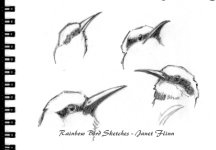
2. Focus on an area e.g. head Return to a pose as the bird does . (Pencil)
|
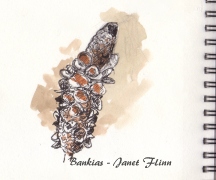
Banksia Pod. (Pen & Watercolour)
|
About the
Author:
Janet Flinn
is one of Australia's finest Wildlife Artists. Janet's paintings
reflect the character of the Australian birds that visit her
garden and nearby bushland in Melbourne. Janet's paintings have
received numerous awards including 'Artist of the Year' in 2005.
Her work has been published in many calendars, magazines,
books and reproduced as cards and prints.
To view some of Janet's paintings and contact the artist, click here.
|
|
| |