|
Thank you for subscribing to
the Wild
Bird
Talking Ezine.
You may forward this Ezine to
your friends. If you have received this issue from a friend and would
like to
receive your no-cost subscription please click
here.
|
|
 |
|
|
|
Back
to the Top |
|
|
| Vicky's Lookout
Welcome
to
this Edition of the Wild Bird Talking Ezine
Dear
Friends,
Vicky has spent the last few weeks sitting on her nest and we are eagerly awaiting the first sightings of the little chicks.
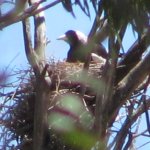
Mindy and Bertie too have been helping her keep the eggs and
young hatchlings safe by sitting on the nest during the wild weather.
We had seen Maggie minding the nest before, so we knew that
Daddy magpies helped keep the hatchlings warm. But this is the
first time we've seen an older sibling sit on the eggs to help stop
them from falling out in stormy weather.
The land is parched with the rains predicted to be late and light this summer. A noisy-miner stepped forward and saved Ron's life while Bertie and Mindy surprised us with their incredible ability to imitate other animals. Aussie figbirds overcame their shyness and that creature sliding in the grass was thankfully not another snake but a beautiful old friend.
Ron and I received training on caring for orphan flying foxes
and we think they are gorgeous creatures. We also hope that there
are very few bat babies who will be in need of care this year due to
their Mums being fatally
injured.
In
this issue we start a new series on 'Understanding Bird Territories'. Reader
Di Swift from Brisbane has sent us two wonderful rescue stories.
One of which completely contradicts the commonly held belief
that magpie parents dive indiscriminately at humans.
|
With
Warm Wishes,
From
Ron, Vicky and me,
Gitie
|
|
|
|
|
|
|
|
|
*****
Reader's Story *****
|
Back
to the Top |
|
|
A Bird In The Hand And A Bird In The Bush
by Di Swift
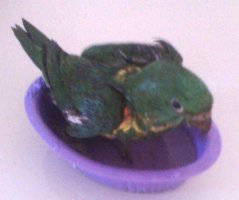 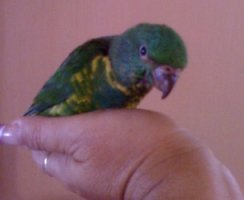
Just over 3 weeks ago Bob was coming back from Biloela and
straddled a scaly breasted lorikeet in the truck, he looked back in
the mirror and stopped as soon as he could (doing 100kms/hr) and ran back
(before another car or truck came closer).
Fortunately, the bird was ok, but Bob could see
it could hardly fly and had hurt its leg, either by falling from nest
(wild winds that day) or trying to grip bitumen as Bob drove over the
top of it...anyway, he picked it up, put it in a box with tissues and
brought it home (early birthday pressie for me....).
He tried giving it at
least water for the 4 hour trip home, but it wouldn't take anything. I
went down to shops and bought a syringe and eyedropper. It took to
both as soon as Bob got home -one with water, one with lorikeet mix -
it was starving! We took her to the vet as her leg wasn't getting any better. The
vet put her on an anti-inflammatory for a week and she's using it now,
still a little lame sometimes but the vet said it would take 2 to 3
weeks, but it is 100% better than what it was.
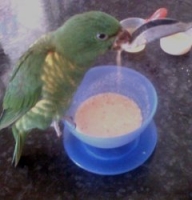 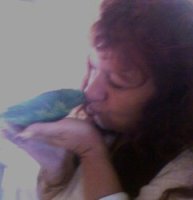
We have named him/her (but we say she) Desi, she's
adorable.
So apart from my other wildlife, day to day chores, kids, Bob
etc....Desi and I have spent a lot of time together. She's
loving her fruit and veges as well as her lorikeet mix...need to
introduce her to some flowers too.
We thought she was about 8 weeks or
so, but we're coming on 4 weeks of having her on Tuesday and her beak
isn't bright orange yet, bottom is orangey and top beak is showing signs
of orange....so maybe she was only about 6 or 7 weeks. We've been reading a
lot and by the sounds of it, their beak is fully orange by 12
weeks (click here to see pics/story of adult lorikeets).
|
 |
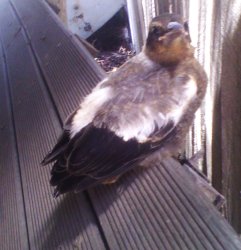 Lo and behold my neighbour a couple of doors
down come running up to me yesterday morning, saying Lo and behold my neighbour a couple of doors
down come running up to me yesterday morning, saying 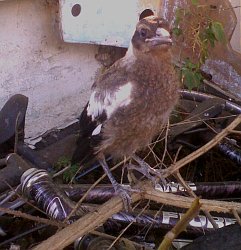
"Di, Di help! You're
the bird lady".
There's a baby maggie on my window sill.
I don't want other
birds to attack it or cats get it!
Help!"
So
I went to her house, there was Mumma magpie (and Papa whom we've never
met until now or hadn't realised he was feeding with Mumma) close
by in the trees. The baby ended up leaving my neighbours and
crossing the road, with us watching out for cars of course....went to
the house across the street and perched itself under a tree for a
couple of hours, again with mum and dad close by...about mid morning it
was out on the road again, so I stayed behind it helping it cross
safely and guiding it into our yard....Mumma and Papa feeding her and
she's taken some from me too (all very exciting). Anyway come
5.30pm or so no sign of Mumma or Papa, we didn't know what to do....we
kept going out every half hour or so and checking it....we didn't know
whether to intervene or leave it, but we didn't want the stray cats
around to get it through the night.....so we placed a crate over her to
keep her safe outside. I set my alarm for 5am and removed it just
as Mumma
was coming to check on her baby, which we have named Tootsie.
Mumma and Papa still seem to be taking food away with them, so
we're wondering if there is still another in the nest, as Tootsie looks
too young to be out....she has no tail, can flutter her wings as she
walks, but not really fly.
I've noticed Mumma and Papa don't worry
about us being around ...touching, feeding etc...its great to be
involved....well off to bed, need to be up at 5am to reunite Tootsie with her parents.
|
|
Di and Bob Swift live in Bald Hills, Brisbane Australia with their beautiful friends. They have the
Tinchi Tamba Reserve Wetlands right at their back fence, so plenty of birdlife
around and occasionally the slippery legless critters.
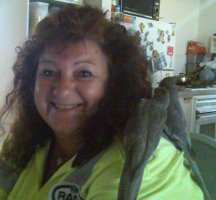
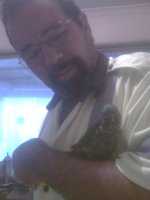
Here you can see Di with Olly and Sweetpea, two of their olive cockatiels. Bob is with Desi.
It's wonderful to hear stories of trust and friendship between magpies and humans. Thank
you Di & Bob for your story & pictures.
-- Gitie
& Ron
|
|
|
|
|
|
|
|
*****
Feature Article *****
|
Back
to the Top |
|
|
Understanding Bird Territories - Part 1
by Gitie House
Why is that cute bird you like
not coming for a drink to the waterbath you have set up so lovingly?
Why were the new birds you saw bathing this
morning chased out by the others? Bird lovers when faced
with such situations are often left wondering if there's anything
they can do to make a difference. 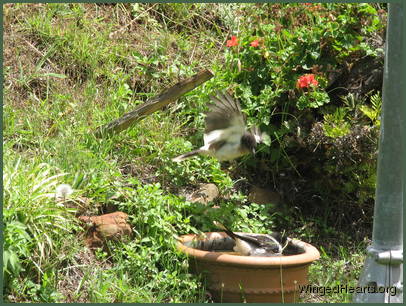
Birds'
territorial rules are complex but definite. They vary with the
species' life style, changing with their age and status within the family
and their relationships in the larger community. That's the nature of a wild bird's life
and while there are no simple 'one size fits all' answers, we do have
some good news. With some basic understanding of the factors
that may be in play, we can take some actions that will enable us to
enjoy the company of our favourite birds for a while longer, or enable
other birds to access critical food and water resources in times of
drought or unfavourable weather conditions.
In the first case above, the bird's reluctance may not be due to
shyness alone but rather because the waterbath is outside their
territory. Each
family or group has an area in which they eat, drink, play and roost in
much the same as humans have houses and yards. If
another family of similar birds (either of the same species, or a
closely related species) lives closer to it, they will have first
rights to the waterbath and they will defend it by chasing the
intruders away.
By placing another waterbath closer to where the birds frolic you can give them their own water source. You may have to
experiment a little to find the spot that is within their authorised areas. The difficulty
for us is that their boundaries are not as apparent to us as our fences
or walls. Birds use features that mean something to them and can
create jagged lines that go across and around ground features such as
mounds, bushes, clumps of grass or eaves, windows, roof tops, poles,
branches and trees. They tell each other by pushing the intruding bird
over their line. 
For example, Larry and Harrie our grey-butcherbirds do not share the
same territory as Butch and Cass the pied-butcherbirds. These
birds, although different species, have the same eating habits, so they
make sure that their territories do not overlap. By placing a
waterbath near our gate, we found that Larry and Harrie could negotiate
an extension to their edge giving them access to water on a
regular basis. This also helped us, as it is much easier for us
fill the waterbowl even at the extremity of our yard, than to troup
across the bush and paddocks to give them an occasional drink.
During years of drought, this has helped keep their family alive
and thriving as well as those of other birds in the vicinity.
Bird territories define the areas where they roost, drink, find
food, nest, raise their chicks and teach juveniles adult ways. In
our observation they can be as diverse as that of humans and accommodate
surprisingly intricate negotiations, bartering and agreements between
parties. When you start communicating with the birds they begin
to perceive you as part of their circle of friends and an important
member of their community, they take your preferences into consideration and accommodate your requests.
Once the birds know that you care about them and also for the
other groups, they will negotiate with each other and often come to an amicable agreement where they share access to you creating a relationship of mutual friendship as can be seen in these real examples.
--------
In 'Understanding Bird Territories - Part 2', we will look at 'Why is your favourite baby bird who is now a young adult and
being pushed out by its parents?' in communicating and building relationships with birds.
* * *
You
can send your questions on any of these steps to editor@wingedhearts.org
and I will do my best to answer them.
|
|
|
|
|
|
|
Back
to the Top |
|
|
Which Bird Am I?
When
Bertie magpie decided to change his demeanour and look one sunny
afternoon, it didn't take too long to figure out what he was trying to
say. Birds use show and tell as part of their natural
communication. But here Bertie shows us another dimension of how
clever they are.
Click
here for the full story and slideshow
Can You Guess?
|
|
|
|
|
|
|
|
Back
to the Top |
|
|
Cuties in the Grass... No, Not A Snake
 If
you only spotted the scales from a distance, you could easily mistake
this beautiful animal for a snake, but it is actually a
Blue-tongue lizard. A friendly and docile creature that keeps the
garden healthy and pest free.
Click
here for the slideshow
|
|
|
|
|
|
|
*****
Site Highlights *****
|
Back
to the Top |
|
|
|
|
|
|
*****
Coming In The Next Issue *****
|
Back
to the Top |
|
|
News and Views from
WBT
WingedHearts.org
proudly presents the Author's Circle Books:
The Power of Giving by Harvey McKinnon and Azim Jamal and The Won Thing by Peggy
McColl
Coming
In The Next Issue:
- Managing Bird Territories - Part 2
- ....and more surprise in the Christmas Edition as Wild Bird Talking turns two!
For Prior Issues visit the Wild Bird Talking Archives
Would you like to submit an
article or your bird story? We would love to
hear these stories and share them with others. Please drop us
a
line at: editor@wingedhearts.org
Invite Your Friends: If you
would like to inform your friends about WingedHearts.org and invite
them to subscribe to the Wild Bird Talking E-zine click
here.
Many Thanks To our Readers: Many thanks
to our friends and readers from around the world
who have visited the site and sent us their comments. We are very
grateful for your support and interest.
Blogs
- Comments: Share your
ideas, opinions and bird friendships by adding comments to the
blogs.
|
|
|
|
|
*****
Subscription *****
|
Back
to the Top |
|
|
Subscription
information:
If you received this message from wingedhearts.org, you are a current
subscriber. To ensure that you continue receiving
our
emails, please add us to your address book or safe list.
If you
received this message from a friend and would like to subscribe at no cost,
please click on the link below and enter details in the left hand menu
bar: http://www.wingedhearts.org
To unsubscribe use the link you received on subscribing or please send
a blank message to subscriptions@wingedhearts.org
with unsubscribe in the subject line.
Share this e-zine with a friend - forward them this e-mail.
|
|
|
|
|
Logo design by Mieke K
All Rights
Reserved. All contents of this e-mail and Ezine are Copyright
2007-2009.
For private, noncommercial use only. Copies must be
unaltered.
Attribution must
prominently state the author's name and that the source of the work is wingedhearts.org |
Back
to the Top |
|
|
|
|
|
|
|
|
|