Dear !fname,

Here is the next issue of Wild Bird Talking Ezine. We hope you enjoy the issue and look forward to your feedback. If you have any trouble viewing the ezine, please contact us at:

    webmaster@wingedhearts.org

With warm wishes
Gitie, Editor


Vicky Feeding Wendy
Wild Bird Talking 
October 2008              WingedHearts.org              ISSN: 1835-6362


Developing understanding and friendship with wild birds


Thank you for subscribing to the
Wild Bird Talking Ezine.  You may forward this Ezine to your friends. If you have received this issue from a friend and would like to receive your no-cost subscription please
click here.


In This Issue:


wbt-logo


*****     Editorial   *****
 
Back to the Top


From Maggie's Perch:~

Welcome to this Special Edition of Wild Bird Talking

Celebrating The First Anniversary of WingedHearts.org

WingedHearts.org is one year old this month and we would like to thank all our readers, contributors and friends for your support and encouragement.  We've had a wonderful and exciting year sharing our experiences of the intelligent and caring natures of the birds and their stories showing the complexity of their social and emotional interactions with others. We are very grateful to all who have let us into their hearts and have sent us their feedback and stories, and also helped us spread the word.

While Maggie has been chasing eagles and hawks, keeping the young nesting and chicks of all birds in the area safe from predators, a pair of Corellas have moved into the area.  The birds in the valley have had both glad and sad tidings. Butchie recovered magnificently and has gone off with her mate Cassie to make the most of her second chance and see the world, leaving their kids to mind their family home. Many thanks to everyone for their well wishes for Butch. Sadly, Sophie magpie also contracted a similar problem, but she did not let us help her, determined to take it in her stride. Her short life journey taught us much about the love and care the birds give their sick, and Ron has posted the details on the blogs. Sophie was the queen of the mulberry tree, welcoming birds of many species to her (and our) backyard, enriching our mutual experience as we extended our friendships with more her friends. She is missed by many, not least her parents Maggie and Vicky, and her youngest brother Monty, and sister Mindy who are all quite distraught. Monty's tribute to his sister has been eye opener to the depth of their capabilities. The valley has been silent for days. Thank you very much to our blog readers for your kind condolences.

Thank you also to all our readers who have sent us the lovely pictures and stories of their birds. We will share these with you on the website and ezine over the coming months.  

As a tribute to Sophie magpie, we dedicate this anniversary special to our humble Australian magpie and bring you two stories from our readers. Matthew tells us about living with Timone, and Judith has a riot with her magpie family Heckle, Jeckle and Speckle.
In Part 4 of Communicating with Wild Birds we look at the ways in which one can continue to build trust and increase our communication with them.

We hope you enjoy the selection of articles and stories and look forward to hearing more of your stories.

With Warm Wishes,

From Maggie and me,

Gitie

   Gitie's photo    wbt-logo

PS: Our next issue will be both the Christmas special as well as the first anniversary of the Wild Bird Talking Ezine, so look out for some nice surprises.


wbt-logo


*****     Reader's Story   *****
 
Back to the Top


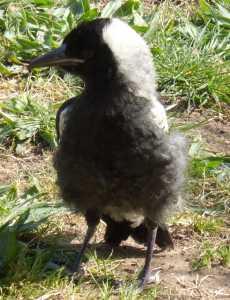
Timone magpie on the ground
Timone as a young chick

Matthew in South Australia has kindly sent us some photos of his beautiful young magpie Timone. Here is Timone's story as told by Matthew:

Last year my son found a featherless hatchling on the footpath and brought it home. We kept the bird in a shoe box with a bottle filled with hot water wrapped in a teatowel for warmth, my wife got up every four hours to feed the chick with pal puppy food and minced up meal worms. As the weeks grew, so did the chick. It was apparent that it was an Australian white backed magpie and we bought the right food for his health and well being. I do know that feeding magpies mince meet is not good for them as I have read so many people rearing these chicks with such food leads to the bird's death as preservatives in mince depletes the bone structure resulting in bone collapse. Timone, as we named him, is now 13 months old he lives and dines with us (lol).

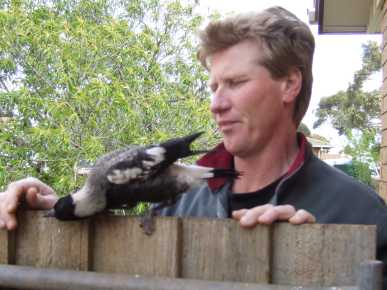
Timone magpie on the fence with Matthew looking on

Timone has an aviary outside as well and has a few friends come visit. We know that rearing a wild bird from a hatchling is different from a wild magpie and releasing him would ultimately result in him being killed, either by his own or falcons etc.

As a protected species we applied for a permit to keep him. I suppose we are one of the very few that knows a magpie better than most, he is vey smart - a lot smarter than we first gave him credit for. Timone is still territorial even with us and protects us as we are his family. He lets some people in and is ok, but some people are scared (of course) and he senses that and plays on it by chasing them around the house. I think he thinks it's funny but we are still very careful when people meet him as he could still inflict damage. We have found that magpies have the ability to be as smart as 3 to 4 year old children. I have now been studying magpies since and understand a lot about them from first hand experience, they are very comical as well and Timone always has us laughing.

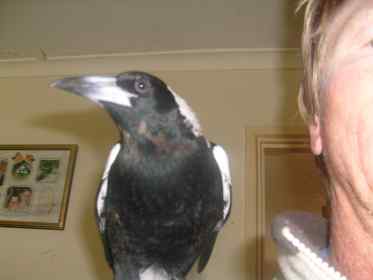
Timone magpie poses for a portrait

From morning when he gets up (as he sleeps inside in his cage and is let out to have the run of the house) till time to go to bed at night, he is into everything. He knows when it is bed time and puts up a fight to get him to bed as only my son and I can do so as he bluffs my daughter with beak snaps and screams at her lol. He also has the cats scared but they are always supervised around him but they run too!

We have bought a bird harness for him and he regularly goes outside for walks as I don't believe in clipping a bird's wings as it's his ultimate defense from predators.
 
We love him very much and he comes first. He does go to the vet for checkups and has a clean bill of health,
 
I suppose we are privileged to have such a beautiful bird living with us. I think some people have the wrong idea about them, after all we all look after our young and protect them with anything we can.


Thank you Matthew for your story and your words of wisdom. In his email to me, Matthew also mentioned the importance of talking to animals in a natural way, much as readers will know we do with Maggie and his family.
 
Lastly, Timone has his own website! There's more photos and video of Timone at http://timonethemagpie.piczo.com . I hope you enjoy it.

Cheers!
Ron.


wbt-logo


*****     Feature Article   *****
 
Back to the Top


Communicating With Wild Birds - Part 4

Responding To Build Trust

by Gitie House


Your wild birds already think of you as a wonderful person. They've been observing you for ages, everytime you freshen their water, refill their seed trays, or play with your pets, and know that you are kind and caring. Once you make friends with a wild bird, you'll find that they treat you with intelligence and care. You become part of their extended community and they begin to let you into their amazingly rich and intricate social life.  

Talking to the birds, observing their individual personalities and quirks, understanding their feelings, helps us form a basis for developing that special personal connection. Having a personal connection with individual wild birds and their families gives them the opportunity to show you their unique natures and their incredible capacity to do something for you. Even birds traditionally known for aggressively protecting their young like magpies and plovers, start treating you as friends and will trust you near their fledglings. 

How can we get them to not react with fright and attack us in return when we are trying to help them or we inadvertantly do something that appears scary to them?  The key to gaining their trust lies in developing that personal connection. The more they know that they matter to us, the more likely they are to listen to us, show us their concerns and overcome their instincts to trust us. Below are some of the ways in which one can show them that they matter to us.

They Know They Matter To You -  When You......

-  Call them by their name and ask after their friends by name. When they aren't around you ask their friends to fetch them. Parent birds especially like you asking about their children.  

-  Arrange another safe place for them to get a drink or feed because you notice that changes in the environment or territorial boundaries prevented them from using the existing facilities.   

- Scold the pushier birds who may be edging them out trying to grab all the opportunities for themselves. Size is not always an indication of aggression. Some of the smaller species can be very cheeky and successfully chase the bigger, shier birds away.

- Check that they are okay, particularly after a storm or stint of bad weather. Birds have a very strong sense of making sure that their flock are all safe and accounted for each day. They check to see if all their family and friends are settled safely for the night and call out to those who may be still about until they return or darkness falls. So they really appreciate your concern as it shows them that you think of them as part of your family.

- Take pictures while talking to them. Once they get used to seeing you put this big box next to your eye and hearing the camera click they will stay while the camera is aimed at them. In fact they feel hurt if the camera is aimed only at the others and they miss out on being the centre of attention.

- Visit their nests and call out to them from a safe distance. Most Mum and dad birds love welcoming friends to see their hatchlings, provided you follow the rules to ensure that the birds do not perceive you as a threat. Firstly you must not be intrusive ever. Make visits to the nesting tree and talk to the birds from a fair distance before the breeding season begins to show them your interest in their lives. Feed the birds to show them you care. When the eggs hatch, help the parents feed the bubs by giving them food especially in harsh conditions. Give the food at some distance from the nest tree, so that when scavengers come to pick the leftovers they are not crowding the bubs in the nest. Keep up your communication with the birds by talking to them while they eat, and when the chicks fledge the parents will bring them to visit you.

- Scold them if they are naughty. Birds have a code of conduct and follow rules within their own communities. Surprisingly, even the shy and flitty birds who flutter off at the slightest movement will stay and listen to you when you're pointing out the rules you want them to follow. Talk to them and their family and explain to them what it is you want them to do, as often as you can. Birds are much more intelligent than most people would believe, but their method of communication is different. Some times it can take them a while to figure out what it is you want, but they will try with amazing results.

 - Make them feel safe and comfortable when they are worried. Predators in the surrounds, lack of food and water, sick children, missing friends, death in the neighbourhood affect birds as much as human. They need reassurance, comforting and consoling. Acknowledging their needs makes them feel loved and understood.

- Do not react with fright to them. Sometimes a bird will get frightened by your movement or something you're wearing or doing. For example, the colour and patterns on your clothes, while of no concern most of the time, can cause some birds to react. Birds eyes and brains are finely tuned to see colours and patterns differently from humans. This enables them to recognise each other individually quickly and at great distances. Even crows, for instance, who seem just odd shades of black to our eyes, have unique shades of dark browns, dark purples and many other hues forming very distnctive patterns to the eye of a bird. Birds also use their wings and tails to form shapes that convey certain messages. If the clothes you're wearing indavertently carries a threatening pattern the bird may react with fear even though they know you. In such situations it is best to talk softly and gently to reassure them that you're still their friend, while moving away from them. Do not force your company on them if you find that its upsetting them for any reason, even though you may not recognise the reason. Instead try again later. The birds will gradually learn that you are 'safe' regardless, or else you will be able to identify the item or action that's causing them concern and make the necessary changes.

Friendships with our avian friends, like all good relationships, has to be nurtured. Developing and keeping trust is an evolving process. Each species has its own characteristics and each bird is unique. The more you talk to your new feathered friends, the more you will learn about them and they will open their hearts and take you on a fascinating journey of discovery filled with love and joy.


--------

In the next part, we will look at  'Making Time For New Friends', in more detail, as with all relationships it's quality not quantity that makes the difference.  
* * *
You can send your questions on any of these steps to editor@wingedhearts.org and I will do my best to answer them.


wbt-logo


*****     Reader's Story   *****
 
Back to the Top


Judith lives in Parramatta and is friends with a local magpie family. The family has had a tough time, but Judith helps out. She originally befriended a magpie pair, Heckle and Jeckle, but after having a child Speckle and the next year two more kids, Judith believes a cat killed Heckle and Jeckle. Then Judith met Speckle again. Here's the story from Judith as of last week:

Judith's magpie friend on the ground

After the disaster of losing my Magpie family, I felt bereft of their company.  I was walking in a nearby park, when I espied a magpie and I called to it. She responded immediately and I spoke to her as I had to the others. I walked home and then found to my surprise the same Magpie sitting on my back verandah - I concluded it must be the adult "Speckle'. She would come each morning and evening at the same time. Then one day she brought a handsome long legged very scared male magpie. He too was young and they bonded beautifully - both coming each day - sometimes wandering into the house if I wasn't quick enough to close the fly screen.  In fact one day in particular I turned from the 'frig to find the male Maggie sitting on my sink!

The magpies getting a snack on the porch

Now, they went through their nesting period and I have fed them on fresh mince each day and evening. I concluded that they had multiple chicks because they were flying out all the time foraging in my garden and hoping I would feed them at all times. This I resisted as I felt they should try for natural food too. I noticed that after laying her eggs, Speckle seemed rather disorientated and often displaying anger towards her mate.  Since about a week ago, I have seen no sign of Speckle.  Father bird has been coming and taking the food and flying back for more - often crying a 'caw' sound for his mate - still no Speckle.  I now presume she has died as no mother Maggie would do this and leave her chicks. Today Father bird has been flying in and out grabbing the food and flying out to the trees nearby. He has two chicks flying! I am worried that he can't look after both of them on his own as he seems to be only feeding one of the chicks.

But there were further developments, and, it seems, three chicks, as Judith has explained:

Of the three little magpies, only one follows the father around my garden squawking incessantly for food - the others stay up in the gum tree whilst in my yard. Somehow this little female even flies onto my Vergola roofed verandah. I have it open so the sun can get in and this little maggie seems to know that I am a major source of food for father magpie. It is often on the ground now fossicking in the garden on its own. I laughed aloud at  its antics a couple of days ago - Father maggie comes into my hobby shed just to reassure himself that I know he's there, the little one thinking he was on to another food source, flew straight into the window of the shed only to find it was closed. It dropped into the garden and flapped about with father maggie looking on anxiously. It emerged covered in webs and flew drunkenly up into the tree.

The family waits on the lawn for a snack

As I hadn't seen much interaction with the rest of his brood, I began to think Father Maggie had forgotten the other two or that disaster had befallen them, but no, two little ones flew down onto my clothes line only yesterday joined by an adult female Maggie. At first I thought I was wrong and that it was Father Maggie, but this beautiful fat sleek female had come to see how things were faring. She flew onto my verandah and took some meat but didn't feed the youngsters, in fact she just flew off and sat nearby, whilst Father Maggie continued his feeding of the babies. About an hour later both of the adults came to my verandah for handouts and they seemed quite amicable towards each other and I was happy that this had occurred, especially to help him with his large family. However, that was the last I saw of her, for the rest of the day only Father Maggie continued to feed his young - maybe it was all too much for her.

[Perhaps] the little female maggie following Father magpie, could have hatched earlier than the other two? I say this as she seems to be advanced in all that she is doing compared to the other two.  It's possible that she has traits of her father as he is a very intelligent maggie - never still - I likened him to a race horse - always on the move.  As soon as he hears my sliding door open each morning - he is there waiting for a handout - tap tapping on the window. The mother maggie (Speckle) was such a love, often sitting by me and carolling, looking piercingly into my face and would just sit quietly taking little tit bits from my hand, knowing I would not refuse her - I sure miss her. In honour of Speckle and of her parents, I have christened the little maggies, Heckle, Jeckle and Speckle!


The lorikeet family on the porch
Thank you so much Judith! Your story shows us all just how much magpies are willing to become friends with humans. Where we live in the coutryside, they even defend us from snakes. I think it is possible the female may yet come back. They seem to 'court' each other and are very fussy about their partners, just like humans. Perhaps she hasn't yet make up her mind?

Judith is also friends with a family of lorikeets. They are so beautiful I couldn't resist showing you their photo.
 
Cheers!
Gitie and Ron.


wbt-logo


*****     Site Highlights   *****
 
Back to the Top


New Site Spotlights @ WingedHearts.org:

This Is Your Life on  Feathery Tales:   
What is this bird trying to tell me? - at  Not Just A Bird... for:  
 New additions at Birds I View:    
 Helping wild birds on Winged Tips;
 Follow the events as they arise - check out the Blogs:
 You can always view your favourites on:    The Sticky Beak,  Grounded!

Every season brings new activity and the stories are never the same, so keep an eye out for the
new releases with announcements in the blogs.  For info on the photographic equipment we use and featured books/dvds visit:  Resources

Tell us your favourite stories and characters by posting comments in the blog or by sending an e-mail to me at: editor@wingedhearts.org


wbt-logo


*****     Coming In The Next Issue   *****
 
Back to the Top


News and Views from WBT


Coming In The Next Issue:


Wild Bird Talking will be one year old in December and we're planning a surprise issue for our readers.

Would you like to submit an article or your bird story?  We would love to hear these stories and share them with others.  Please drop us a line at: editor@wingedhearts.org

Invite Your Friends:  If you would like to inform your friends about WingedHearts.org and invite them to subscribe to the Wild Bird Talking E-zine click here.

Many Thanks To our Readers:  Many thanks to our friends and readers from around the world who have visited the site and sent us their comments. We are very grateful for your support, and interest.
Blogs - Comments: Share your ideas, opinions and bird friendships by adding comments to the blogs.  


wbt-logo


*****     Subscription    *****

Back to the Top


Subscription information:


If you received this message from wingedhearts.org, you are a current subscriber. To ensure that you continue receiving our emails, please add us to your address book or safe list.

If you received this message from a friend and would like to subscribe at no cost, please click on the link below and enter details in the left hand menu bar: http://www.wingedhearts.org

To unsubscribe use the link you received on subscribing or please send a blank message to subscriptions@wingedhearts.org with unsubscribe in the subject line.


Share this e-zine with a friend - forward them this e-mail.


wbt-logo


Logo design by Mieke K
All Rights Reserved.  All contents of this e-mail and Ezine are Copyright 2008.
For private, noncommercial use only.  Copies must be unaltered.
Attribution must prominently state the author's name and that the source of the work is wingedhearts.org
Back to the Top