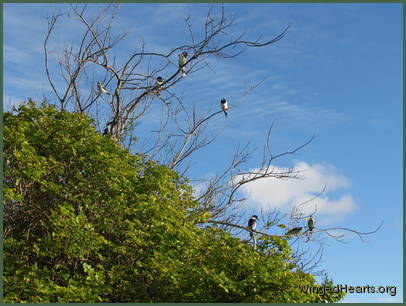
Six Tips
for Recognising Individual Birds
by Gitie House
'How do you know which is which, so you can name them and tell them
apart?' is a question I get asked quite often. Recognising
individual birds in some species can be quite a challenge for human
eyes. Our brains are not designed to instantly pick the fine
patterns of a bird's plumage or the small distinguishing features in
other parts of their body. Many birds are too small and don't
sit
still long enough at close distances for the human eye to take in all
the details and start building a clear recognisable memory of each
bird. A bird's brain is optimised for recognising minute
variations in the colours and shapes that form the
distinguishing
features of their species and also other birds and animals.
They
also have the additional advantage of being able to clearly see a wider
range of colours in the indigo to violet and black range. So
they
can tell the distinguishing features from a great distance and
recognise each other as comfortably as humans recognise each other and
each species is optimised for itself. In this article I
describe the six key features to look for in recognising
individual birds.
1.
Shape, Form and Size:
For each species the first step is to look for differences in their
general body shape. From a distance see which bird appears
bigger, fatter, shorter, slimmer, taller? How do hold their
bearing? What angles do their necks and shoulders make when they look
straight at you, or up in the sky or down at the ground. Do they appear
fatter at the neck or at the abdomen. Some are more pear
shaped
others are like apples and some are like bottles.
2.
General Appearance:
Next look at their wing structure. Does the bird droop any of
its
wings? If so, how much? How do the wings sit on the tail?
Is it neatly crossed or left loosely open? Is the
bird
tidy, compact, petite, elegant or scruffy looking? Are the
feathers on top of their head smooth or fuzzy? If they are
crested, what is the shape and size of the crest?
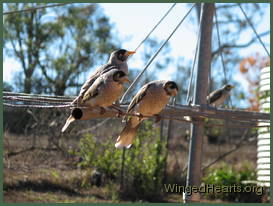
Feathers
form detailed patterns which are unique for each bird. Birds brains can
easily pick the minute distinctions and variations in the colours and
intricate shapes, just the way we recognise faces.
|

The
shape of the mask around the eyes, under the chin as well as the marks
where the beaks meet the cheek are all individual characteristics.
Renutu (noisy-miner) does not have a goatie in the centre of
his
mask.
|
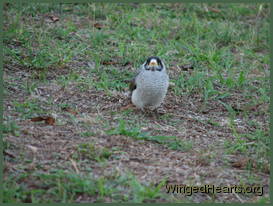
Chipkin
(noisy-miner) (above and right) is the smaller, more compact
and has a little goatie under
her beak unlike Renutu in the picture above right.
Chipkin is also
lighter in
colour at the front.
|

Looking
from the side Chipkin does not have the light stripe along the edge of
her wing around the midway unlike Renutu in the picture above.
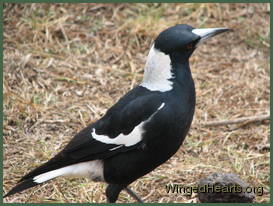
Also
look at the pattern under the tail of Sophie magpie and the shape of
her neck and beak. These too are distinctive features. |
3.
Posture and Movement:
Watch
for
differences in the way they move. How does the bird look when
landing, taking off, walking or hopping around the ground? Does the
bird waddle or does it daintily lift one leg before the other.
Does the bird generally hunch its shoulders or is it relaxed?
How
does the bird usually sit? How close is its abdomen to the
ground
under normal relaxed conditions and what shape does the body make in
this position.
4.
Plumage Patterns:
Every
bird has a
unique pattern in their feathers. Look for
variations in
colour, shape and lines formed by their feathers on the back, side,
neck, head, abdomen, thighs and tails.
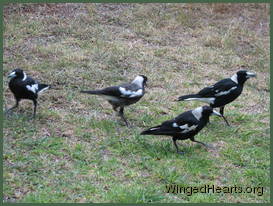
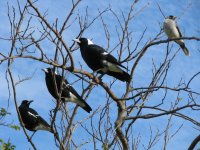
From
left - Sophie, Wendy, Vicky (front) and Maggie magpies.
The
shapes and size of the white patterns are easily
distinguishable
in each bird in the wings, back of the neck, under the tail and flanks
of the thighs.
Vicky
is also thicker necked than the others, while Maggie is the bigger
bird, Sophie is slim, while taller than her Mum Vicky and shorter than
her Dad Maggie. |
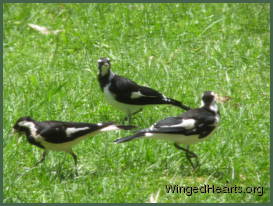
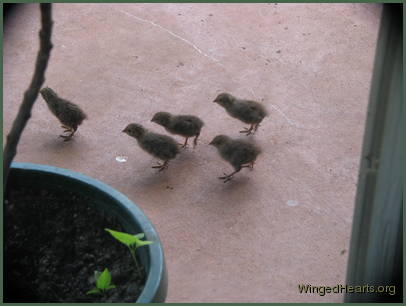
A
young peewee family.
The
white patterns are again different in each bird, even though their
sizes are similar. The way each bird has folded its wings on
the
tail is also different. Every bird has its preference whether
it's
left over right, meeting perfectly at the centre, or right over left,
or
leaving a gap (as in Vicky in the picture on the left).
|
5.
Beaks and Eyes:
All
birds have
distinct beaks and eyes. If a bird comes close enough to you,
you
will see that the shape and colour above the beak and near the
nostrils, the way the two parts of the beak meet, the shape of the full
beak itself and the angles formed on the cheeks are clearly different.
The shape of their eyes and eyebrows are similarly unique and
the
look of each bird is as individual as a human.
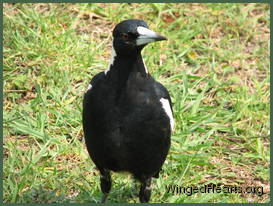
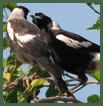
Philly
and Sophie are twins. Philly (above) has a thinner neck than
her
twin Sophie (right). She also has patches of white on her
thighs.
|
Sophie's
beak has a long line just above the centre, while Philly only has a
short line (this can be different on each side of the face).
Philly's beak forms a circular pattern at the top where it
meets
the head, while Sophie's is more angular. |
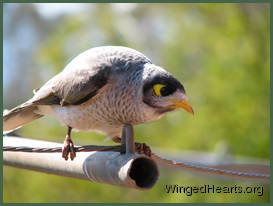
The
markings on the beaks, the shape of the eye mask, the size and shape of
the eyes, the width of the forehead, patterns of the collar and goatie
all contribute the distinctive look of each bird.
|
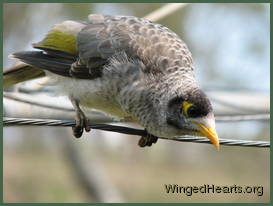
In
reality, even the claws are different, but these are much harder to
spot unless characterised by some unusual deformity.
|
6.
Behaviour and Sound:
How
a bird
behaves when its at the water bath, eating, drinking or just
roosting on the perch is as characteristic of each personality as it is
humans and animals. Cindy magpie loved scrubbing every piece of food in
the grass while her sister Tammie picked up each piece cleanly.
Renu noisy-miner would come and sit at our feet, while his
younger brothers Renutu would hover over our shoulder. The
birds
like being recognised, its part of building a personal connection.
Each bird also makes a unique signature sound which acts like a name.
Listen for these calls. As you name your birds,
they will
respond by trying to imitate your call for them. Often they integrate
this into their signature sound making it much easier to
recognise
them.
As
our eyes get used to looking for these features, our
brains learn to quickly recognise the unique patterns.
Don't
despair if
you can't tell some of them apart. The birds know that this
is not one
of our strengths, so they will find ways of helping us.
--------
In
the next edition, we will look at ' The
Power of Thank You'
in communicating and building relationships with birds.
* * *
You
can send your questions on any of these steps to editor@wingedhearts.org
and I will do my best to answer them.
|