|
Thank you for subscribing to
the Wild
Bird
Talking Ezine.
You may forward this Ezine to
your friends. If you have received this issue from a friend and would
like to
receive your no-cost subscription please click
here.
|
|
 |
|
|
|
Back
to the Top |
|
|
A Bird With A Mission
Welcome
to
this Edition of the Wild Bird Talking Ezine
Dear
Friends,
We
hope
you've all had a good start to the new year and are navigating your way
safely through these tough times of the global economic
crisis and also the extreme weather conditions in many parts of the
world. Our hearts are with the victims of the bushfires in Victoria and
the massive floods in North Queensland. We also feel deeply for the
wildlife and the loss of their habitat; they are sadly the silent
victims of these disasters. Donations can be made to Wildlife Victoria
Bushfire Appeal here.
While we
were fortunate to escape the worst of the storms this season, our
yard has not been free of sorrow. With a heavy heart I bring
to you the sad news of Maggie's passing. Maggie
had been feeling low since before Christmas, and although there were
some bursts of recovery, his health continued to decline until his
transition on the
night of 26 January.
Thankfully he was in our arms, comfortable, safe and loved.
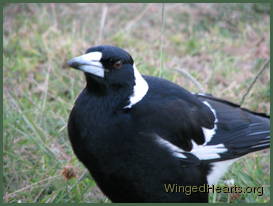 Maggie
- An Inspired Life (2000 - 2009)
Maggie
- An Inspired Life (2000 - 2009)
Maggie
was always a bird with a mission and his actions were just as
inspirational in his sickness as they had been throughout his life.
We were very privileged when he voluntarily came into
the cage on his last day so he could be with us during his last hours.
Vicky and the kids Mindy, Monty and Georgie wanted him to
have the safety and comfort of our company, and for that too we are
very
grateful to these beautiful and generous birds. To
read about Vicky's tribute to Maggie in Our Sweet
Maggie click
here.
We would like to express our sincere appreciation to Christine
Agro (host of Conscious Animal Radio and animal communicator) for
alerting us to Maggie's condition and for all her advice regarding natural
remedies that can help wild birds and also in communicating with
Maggie
what we wanted him to do in the cage. Our sincere gratitude also
to wildlife carers Jenny Foley and Peter Richards for all their help
and
care.
Maggie's
friendship with our dogs Scottie and Benny started us on the journey of
friendship and discovery of wild bird culture, and his legacy
will
continue through WingedHearts.org, the Wild Bird Talking Ezine, and a
number of books that we are writing about the richness of
their
lives, the intricacy of their society, their incredible depth
of
awareness, capacity to love and communicate. These include the
story journey of discovery, friendship and adventure with Maggie and
his family, amazing facts about wild bird culture and communicating
with wild birds.
In
this issue we are privileged to bring you the story of another kind of
winged heart when reader Jenny shares the story of her beautiful friend
Suna. In Communicating
with Wild Birds - Part 5 we look at making time
for our new friends.
With
Warm Wishes,
From
Ron, Vicky and me,
Gitie

|
True
Friends to the end - Maggie and Minnie.
Click on the picture for the slideshow
|
|
|
|
|
|
|
|
*****
Reader's Story *****
|
Back
to the Top |
|
|
Also
A Winged Heart
From
Jenny Foley
 |
|
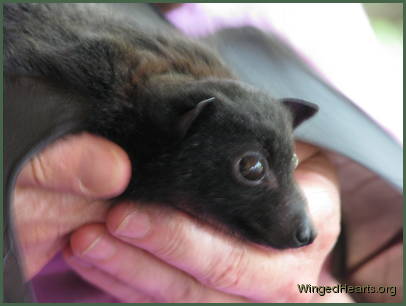
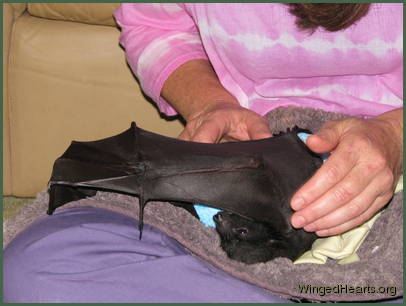
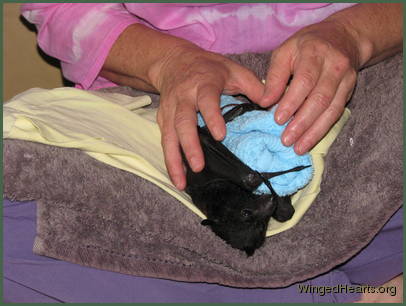
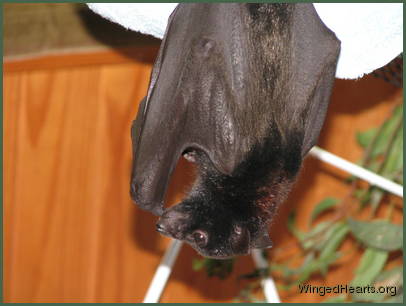
Flying foxes are winged hearts too! These beautiful and
gentle big bats live in forests, feeding on blossom, nectar and fruit.
They have been called 'nature's gardeners' as they play a vital role in
seed dispersal and are attributed with having planted many of the
forests of the world. Hundreds of
babies become orphans in the storms from October to January each year.
Bat Rescue groups do their best to rescue the babies and treat the
injured
but the demand is overwhelming and they rely on volunteers all around
the state to help feed and care for these beautiful and vulnerable
creatures.
Jenny has been caring for orphaned wildlife for many years now. Caring
for Suna has
been one her most heart warming experiences. |
| Baby flying foxes are completely dependent on their
mothers
for the first 4 months of their lives. For the first four weeks they
are constantly with their mothers, being wrapped up within her wings,
staying close to her heart and
receiving her constant affection and care.
They are extremely intelligent and loving animals and they have
close relationships with the other members of their family.
Once they start flying they learn the bat ways from the other
members of their community. |
|
 |
 |
|
Bat carers are very special people as they rise to the
challenge of providing love, care and nourishment to one of nature's
misunderstood species. The Bat Rescue groups provide training and
detailed instructions to bat carers about the type and quantity of food
that must be fed to the babies. After 14 weeks the bats
are taken to a bat creche where they learn to socialise with
other
bats and lose their dependence on humans, in the comfort and safety of
the creche facility. They are released at a large bat colony when they
are strong enough and capable of returning
to their natural
environment. Bat
carers also need to get immunised against lyssavirus, even though the
disease is rare, before they can handle
bats. |
When Jenny told me that I would fall in love with Suna,
I
thought she was just being an enthusiastic and loving foster mum.
But Ron and I both fell in love with Suna and started our course
of immunisation injections the very next week. We too are
looking
forward to caring for some of these gorgeous animals next season.
Thank you Jenny
for sharing the story of your beautiful Suna and
introducing us to the joys and wonders of the flying fox.
Cheers
Gitie and Ron |
|
|
|
|
|
|
|
*****
Please help the bushfire wildlife Victims *****
|
Back
to the Top |
|
|
Wildlife
Victoria
BushFire Appeal
Sam
who later turned out to be a female koala has become the face of the
wildlife victims of the Victorian Bushfire that has taken over 200
human lives, and its estimated over one million native animals.
According to the Wildlife Victoria website, 'the current fire situation
has left its devastation on our wildlife
including the loss of at least two wildlife shelters to the
fires.
Wildlife Victoria are trying to ascertain the safety of other shelters
in the fire areas and to offer support and help with evacuation of
animals already in their care if they need it.
Wildlife Victoria volunteers are working in all fire damaged grounds
performing search and rescue. Hundreds of animals have been taken in for
treatment and rehabilitation, with more coming in all the time. Food
drops are being made for those animals we can't find or reach.
 The treatment and
rehabilitation of a single burnt koala costs over $400
per week, and can last many, many months. Please help us continue to
save animals' lives long after the camera and glare of the media have
gone.' The treatment and
rehabilitation of a single burnt koala costs over $400
per week, and can last many, many months. Please help us continue to
save animals' lives long after the camera and glare of the media have
gone.'
To make a donation to Wildlife Victoria's
Bushfire Appeal 2009, please
click here.
--------
|
|
|
|
|
*****
Feature Article *****
|
Back
to the Top |
|
|
Communicating
With Wild Birds - Part 5
Making
Time For New Friends
by Gitie House
Let's
face it, one of the biggest challenges in communicating with wild
birds is finding the time to spend with them. Wild birds are
outdoor creatures and spend all their lives in the trees or under
shrubs, around paddocks, or in ponds as the case may be. Many people,
are like me and spend a lot of their time indoors.
Even folks whose
work or hobby
enables them to stay outside for significant periods of time, are busy
with their commitments and seldom able to spend their time observing
their avian friends. When something important arises in a
bird's
life, the
birds do not just come to us and say 'Hey, something interesting is
happening in our community, come and have a look'. And when
they
do,
we cannot reply 'sorry mate, tell them to hold off until next Saturday
10.00 am, because I'm not free before then'. If you don't
respond in the moment, you could lose a vital opportunity to share
something essential from their life, perhaps discover another amazing
fact and
deepen that precious relationship.
Most
of
the days in a bird's life are full of ordinary humdrum
activities interspersed with long periods of silent stillness. Trying
to watch them for long periods of time is not always practical, and days
can go by without discovering anything new. While it's not
always
practical to drop everything you're doing and rush outside every time
you hear a call, you do want to be able to recognise the times when it
is crucial to respond immediately and follow up on
their activities outside. To achieve this you have
to build
your own knowledge of the patterns of behaviour of your individual bird
friends, their friends, and the general bird community in your backyard.
This can only be done over time but the steps are relatively
easy
to follow.
Keys
To Building A Relationship Even In Busy Lifestyles:
1.
Make time for regular interaction and make it interesting:
In
your schedule allocate some time when you can spend some
uninterrupted time with your birds. This
can be early in the mornings for breakfast or just before dusk for
supper, or perhaps you can only make time once daily or twice weekly or
only on the weekends. Birds are master observers of patterns
of
behaviour, they will pick the routine you create and soon learn when to
interact with you. Make these times interesting for both the
birds and yourself. Call them by their names or when you're
ready, give them some food and talk to them. If they show interest or
just look cute, comment on what you see. Ask them questions.
The birds will start to learn your tones, sounds and body
language. If they jump around or fly to the other side,
follow
them to see what they're trying to show you. This tells them
that
you're listening to them, taking an interest in their activities and
want to know more. If they talk to you, acknowledge them.
When
they're leaving thank them for coming and making time for you.
2. Build a
knowledge base about the seasonal life cycles and lifestyles of the
species in your area:
Find out all you can from books in the library or local bird watching
groups about the seasonal events in the birds lives. Once you
know when they are likely to mate, their breeding cycles, where they
build their nests, the types of nests, their allies, their enemies,
their mating calls, alarm calls and general information about the
species, you form a better idea of when major changes are likely to
occur. This information is very helpful in knowing what is
likely
to happen in your birds life at various times in the year and you can
look out for it or note variations from it. Knowing
the
general pattern of some of the more common species around you also
give you a head start in noticing the interactions amongst the species as
the cycles overlap or diverge.
3.
Develop your own insight into your particular bird friend's
individual habits and community interactions:
As you get your birds better, you will have insights into their own
individual personalities, attitudes, preferences and styles.
The
more you talk with them, the more you become their confidant and
friend. They begin to introduce you to their other friends,
share
with you their secrets, and include you in their negotiations.
4.
Listen for cues in the sounds the birds make for a
different message:
Are they using a different tone of voice or sitting on different perch?
Where is their attention? Are they busy listening
to the
sounds other birds are making? What sounds comfort them and
which
sounds cause them alarm? How do they respond to the environment?
All this tells you what to look for and your knowledge base
expands.
5.
Notice changes in their behaviour:
Do they look different? Are they distracted? Are
they not
talking to you as much? What are they doing instead?
How
many of these variations can you relate to the information you have
gained about their species generally? Do they look anxious or
sick? Are they trying to tell you something?
Ask them
to show you.
6.
Keep a daily journal and look for wider patterns and stories
that emerge over time:
Keeping a journal is the best way to keep track of what's happening in
your birds life. In the beginning, you will have much to
write
about as a lot of information will be new. After a few
months,
you'll note only things that haven't been recorded before. As
you
compare the activities, you'll see broader patterns and see how their
community life develops. You can take photographs as well.
Digital cameras have made this extremely easy and inexpensive.
Photographs also serve as good memory joggers and story tellers.
Before long you will be able to recognise a range of regular events and pick the
unusual activities that warrant further attention. But remember, each
season is different and no matter how much we learn, there's much we
don't know and the birds can always surprise us with the depth of their
consideration and care.
--------
In the next edition, we will look at 'Tips For Recognising Individual Birds',
in more detail.
* * *
You
can send your questions on any of these steps to editor@wingedhearts.org
and I will do my best to answer them.
|
|
|
|
|
*****
Promotion - Preview Teleseminar *****
|
Back
to the Top |
|
|
A No Cost Teleclass on How to Become an Amazon.com Bestseller (time sensitive)
Kathleen
Gage has successfully
launched several Amazon.com bestseller campaigns for herself and other
authors. Her most recent campaign was with an author who made it to #1
in Hot New Releases in three categories. Prior to the book launch very
few people knew about the book. Now it has a global reach. If
you are an author (or soon to be) and would like to learn how
to do their own Amazon.com
bestserller campaign,
then
you will definitely want to register for
Kathleen's no cost teleclass "How To
Turn
Books into Amazon.com Bestsellers while Increasing Your Visibility,
Revenue and Credibility"
Thursday,
February 26, 2009
6
- 7 p.m. Eastern
Register
now!
Amazon
preview call (click here)
In
this one hour teleclass you will.....
- Discover
the #1 mistake most authors make that
prevents them from selling lots of books.
- Learn
what you absolutely must do before you
ever launch a campaign
- Learn
how to determine if this type of marketing and book
selling strategy is for you.
- Learn
how to avoid spinning your wheels trying
to figure the system out and missing essential ingredients to success.
- Find
out about 1 simple thing you can use
right away to begin the pre-launch of your book.
- Discover
how to set yourself up for long-term success
and make 2009 your best year ever with my simple, "Vision Your Future"
Plan.
This
is the first time Kathleen is offering the information you will be
learning in this format.
She may never offer this type of session again. So
if you are ready to become an Amazon.com bestseller in 2009 register
now while it's fresh on your mind.
I'm a great fan of Kathleen's work and I know that she will teach more in one hour than most people learn after months (or
even years) of searching out information on how to sell more books,
increase visibility and expert status and increase revenues.
To
learn more and register for this no cost call go to
Amazon
preview call (click here)
Even
if you can't make it, go ahead and register to receive the download
link to the recording.
Cheers
Gitie
--------
|
|
|
|
|
*****
Site Highlights *****
|
Back
to the Top |
|
|
New Site
Spotlights @ WingedHearts.org:
Birds
I View
The
Sticky Beak:
Grounded!
Follow
the events as they arise - check out the Blogs:
Winged
Tips:
You can always view your
favourites on: Feathery
Tales, Not
Just A Bird...,
Every season brings new activity and the stories are never the
same, so keep an eye out for the new
releases with
announcements in the blogs. For info on
the photographic equipment we use and featured books/dvds
visit: Resources
Tell us your favourite stories and characters by posting comments in
the blog or by sending an e-mail to me at: editor@wingedhearts.org
|
|
|
|
|
*****
Coming In The Next Issue *****
|
Back
to the Top |
|
|
News and Views from
WBT
Coming
In The Next Issue:
- Special Edition on Juvis (juveniles) - quails, peewees, butcherbirds and more
- Tips For Recognising Individual Birds
For Prior Issues visit the Wild Bird Talking Archives
Would you like to submit an
article or your bird story? We would love to
hear these stories and share them with others. Please drop us
a
line at: editor@wingedhearts.org
Invite Your Friends: If you
would like to inform your friends about WingedHearts.org and invite
them to subscribe to the Wild Bird Talking E-zine click
here.
Many Thanks To our Readers: Many thanks
to our friends and readers from around the world
who have visited the site and sent us their comments. We are very
grateful for your support and interest.
Blogs
- Comments: Share your
ideas, opinions and bird friendships by adding comments to the
blogs.
|
|
|
|
|
*****
Subscription *****
|
Back
to the Top |
|
|
Subscription
information:
If you received this message from wingedhearts.org, you are a current
subscriber. To ensure that you continue receiving
our
emails, please add us to your address book or safe list.
If you
received this message from a friend and would like to subscribe at no cost,
please click on the link below and enter details in the left hand menu
bar: http://www.wingedhearts.org
To unsubscribe use the link you received on subscribing or please send
a blank message to subscriptions@wingedhearts.org
with unsubscribe in the subject line.
Share this e-zine with a friend - forward them this e-mail.
|
|
|
|
|
Logo design by Mieke K
All Rights
Reserved. All contents of this e-mail and Ezine are Copyright
2007-2009.
For private, noncommercial use only. Copies must be
unaltered.
Attribution must
prominently state the author's name and that the source of the work is wingedhearts.org |
Back
to the Top |
|
|
|
|
|
|
|
|
|