|
Thank you for subscribing to
the Wild
Bird
Talking Ezine.
You may forward this Ezine to
your friends. If you have received this issue from a friend and would
like to
receive your no-cost subscription please click
here.
|
|
 |
|
|
|
Back
to the Top |
|
|
| Vicky's Lookout
Welcome
to
this Edition of the Wild Bird Talking Ezine
Dear
Friends,
Vicky has been
flanked by suitors all season as readers of our blogs will know. Ron
and I held our breath while we watched Vicky rejecting a string of young magpie gentlemen. There was one very persistent bird we named Ritchie who we thought he might succeed in winning Mindy and Monty's approval, when he too was shown the way out. Vicky and Maggie had met in June
and with August approaching the breeding season is well upon us.
After many anxious weeks of pondering Vicky's future we were
pleasantly surprised to be introduced to Bertie,
a magpie of fine breeding as we are discovering. Bertie's lost no time
in demonstrating his leadership skills in helping Vicky and kids stand
up to intruders and cheeky neighbours. To add to our delight
Bertie has a fine voice and the air is filled with beautiful carols
from the Vicky four.
Activities for those us ground bound have been just as exciting. The birds always protect us from us from snakes and Ron got the chance to help them this time. Bowerbirds have been enjoying the lilypot and the camera was at hand to capture some tender loving moments between two of the joeys who frequent our yard and we finally got some nice pictures of bell miners.
In
this issue we look at the power of saying thank you to the birds. Reader
Claire Muskus from Connecticut discovered a wealth of hidden treasure
in her barn and shares her stories and pictures of sparkling
diamonds.
|
With
Warm Wishes,
From
Ron, Vicky and me,
Gitie
|
|
|
|
|
|
|
|
|
*****
Feature Article *****
|
Back
to the Top |
|
|
The Power Of 'Thank You' in Communicating With Birds
by Gitie House
 Birds understand being thanked and respond to it in remarkable ways.
A few years ago, on one of our walks, Ron and I saw a flock of
thornbills hopping in the middle of a paddock some distance away.
Thornbills are tiny birds barely 10 cms from the tip of their
beak to the end of their tail. They looked like leaves being
blown along the ground by the wind. That rolling
motion caught our eye initially and it was a while before we
realised that these were the small birds more commonly called yellow
bottoms that lived in the fields. Thornbills do take fright
easily and seek safety in thick, shrubby bushes, taking flight at the
slightest hint of movement. We had tried spotting them on
previous occasions, but the birds would fly off long before we could
raise our binoculars in their direction. On this occasion, we
took some shots from the distance, even though through our zoom lens we
could barely capture any details of these birds. Did the birds know we
were around? Would birds as small as the thornbills understand what we were trying to do and
say? We had no idea, but still, we thanked them before continuing
on our walk.
Birds understand being thanked and respond to it in remarkable ways.
A few years ago, on one of our walks, Ron and I saw a flock of
thornbills hopping in the middle of a paddock some distance away.
Thornbills are tiny birds barely 10 cms from the tip of their
beak to the end of their tail. They looked like leaves being
blown along the ground by the wind. That rolling
motion caught our eye initially and it was a while before we
realised that these were the small birds more commonly called yellow
bottoms that lived in the fields. Thornbills do take fright
easily and seek safety in thick, shrubby bushes, taking flight at the
slightest hint of movement. We had tried spotting them on
previous occasions, but the birds would fly off long before we could
raise our binoculars in their direction. On this occasion, we
took some shots from the distance, even though through our zoom lens we
could barely capture any details of these birds. Did the birds know we
were around? Would birds as small as the thornbills understand what we were trying to do and
say? We had no idea, but still, we thanked them before continuing
on our walk.
 On our return trip, we slowed down near their area
to take some pictures of a willy-wagtail on the fence. We thanked the
willy-wagtail too. Just then, much to our surprise the flock of
thornbills flew over from the middle of the paddock to the road,
settling right in front of us. Normally they would have headed straight
for the dense shrubs on the other side of the road and stayed out of
sight. We clicked away as gently as we could and kept thanking them.
The birds accompanied us on our walk back (for as long as there were
shrubs they could use as shelter should the need arise), staying in
front, unafraid of our movements or the clicking and pointing of
the camera. These birds did not know us, they did not live in our
yard or get any feed from us or bathe in our bird baths. But
they had understood us thanking them and they lost no
time showing us that they too could thank us in return. The pictures above and on the right is much enlarged, click here for the full story and slideshow. On our return trip, we slowed down near their area
to take some pictures of a willy-wagtail on the fence. We thanked the
willy-wagtail too. Just then, much to our surprise the flock of
thornbills flew over from the middle of the paddock to the road,
settling right in front of us. Normally they would have headed straight
for the dense shrubs on the other side of the road and stayed out of
sight. We clicked away as gently as we could and kept thanking them.
The birds accompanied us on our walk back (for as long as there were
shrubs they could use as shelter should the need arise), staying in
front, unafraid of our movements or the clicking and pointing of
the camera. These birds did not know us, they did not live in our
yard or get any feed from us or bathe in our bird baths. But
they had understood us thanking them and they lost no
time showing us that they too could thank us in return. The pictures above and on the right is much enlarged, click here for the full story and slideshow.
The
thornbills rewarded us again a few weeks later, when on hearing our
voice, one of them came out alone, exposing him/herself, sitting out on
the branch and singing for us, until we decided to leave. A year
later they still remembered us and another six months on they are even
friendlier than before. Those brief thank-yous spoken almost to
the air has helped build a long term relationship with little creatures
we visit for short brief moments very occasionally --- so
powerful is this simple word.
In our experience, birds who are new to human communication respond to
'thank you' more favourably than
they do to a 'hello'. A 'hello' from a stranger can make a bird feel
self-conscious. If they are unused to humans
talking to them, the sudden attention may cause some anxiety as
they don't know how to respond in a meaningful way. But the word 'thank you' has
a spirit and an energy of its own. It's in our eyes, our head, our
whole body language, the tone of our voice --- a heartfelt 'thank you' conveys not
only appreciation and good will but also the message that the recipient has
the ability to comprehend and is worthy of acknowledgement. The
birds respond by rising to the occasion because now they also know that
the humans are capable of comprehending them and recognising their good
intentions.
For their part birds know how
to show their thanks. They will come and sing for you, play in your water
baths, pose for photographs, call out to you when there are matters of
interest in the sky or yard, let you know when a stray dog or cat jumps
over the fence and steals your pet's food, chase snakes out of your
yard, fetch your favourite birds if they are out of hearing when you
call; and even the scavengers will show you their appreciation for the
scraps of food you throw out. Rescued birds have been known
to help find their rescuers' lost bracelets, earrings and watches. It
all depends on how open we are to 'listening' to them when the occasion
arises and letting them show us what they can do to help us. But do
they understand us when we say 'thank you' to them?
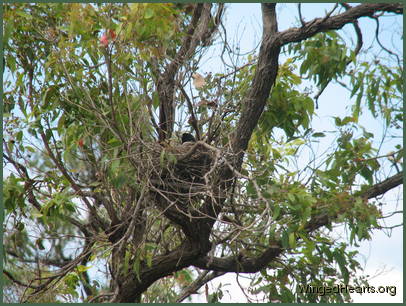 Another time we went a long trek to find the nest of Larry and Harrie
the grey-butcherbirds that visit the fringes of our yard. The birds had
not visited us for weeks and we were concerned that they lost their
nest in the storms and perhaps sustained injury themselves.
Seeing us in a neighbouring field, the birds called out to us and
we responded by travelling in their direction. We had to cross
some fences and walk around a gully to the other side of the valley
before we could spot their nest and assure ourselves that the pair were
okay. The birds sang a new song as we returned. From the
tone, phrase and pitch of their sounds there is no doubt in our
minds that they were saying thank you, they were so delighted that we
had gone to see them. (Click here for the full story and slideshow.) Larry is the bird that, even though his
territory did not extend to our house, and he had not visited the
outskirts of our yard for months, at the first sound of a snake
approaching me, flew into what was alien territory for him and began to
chase it away. His sounds alerted Maggie magpie and the other birds who
then joined him in his efforts (for a slideshow of another snake chase click here).
Another time we went a long trek to find the nest of Larry and Harrie
the grey-butcherbirds that visit the fringes of our yard. The birds had
not visited us for weeks and we were concerned that they lost their
nest in the storms and perhaps sustained injury themselves.
Seeing us in a neighbouring field, the birds called out to us and
we responded by travelling in their direction. We had to cross
some fences and walk around a gully to the other side of the valley
before we could spot their nest and assure ourselves that the pair were
okay. The birds sang a new song as we returned. From the
tone, phrase and pitch of their sounds there is no doubt in our
minds that they were saying thank you, they were so delighted that we
had gone to see them. (Click here for the full story and slideshow.) Larry is the bird that, even though his
territory did not extend to our house, and he had not visited the
outskirts of our yard for months, at the first sound of a snake
approaching me, flew into what was alien territory for him and began to
chase it away. His sounds alerted Maggie magpie and the other birds who
then joined him in his efforts (for a slideshow of another snake chase click here).
The anecdotes recounted above are only a few examples. So, when
is the best time to thank the birds?
We started thanking our birds from the beginning, from the first time
that Maggie came to us when we called his name, we thanked him. We thank the birds as often as we
would thank our human friends: for coming to see us, for singing
sweetly, for showing us the eagle, for posing for a shot, for letting a
bird from another territory pose for a shot, for sharing what we give
them with their friends, for telling us when the waterbaths that are
further from the house need refreshing, for worrying about us if we've
been away, for showing us their love, for having the courage to
overcome their instincts and be our friends. With strange birds,
we just thank them for making eye contact. I encourage you try it for
yourself and experience its magic as it transforms your avian
visitors to friends.
--------
In
the next edition, we will look at 'Managing Bird Territories'
in communicating and building relationships with birds.
* * *
You
can send your questions on any of these steps to editor@wingedhearts.org
and I will do my best to answer them.
|
|
|
|
|
|
*****
Reader's Story *****
|
Back
to the Top |
|
|
Sparkling Diamonds In The Barn
by Claire Muskus
Photographs
by Maresi Von Halem
When
Claire saw
a pair of swallows busily flying in and out of a corner of the
barn, she
couldn't help but take a closer look ---
 In
the barn where I board my horse, there are approximately 5 or 6 pairs
of barn swallows chirping their glee at returning and building nests to
lay their young. I've never had the pleasure to witness this
and I'm quite anxious to view them. The nests are
unbelievable in that they're made with mud/straw/horse hair (both of
which hang down); I've watched them pack all this in to form a 'little
fortress' on perches that the owner of the barn has
made. The birds fly in and out of the barn at great
speed; I can't tell you how many times I've almost been hit in the face
by them and I can't wait for the young to join in song ~ I would think
it would drive the horses batty, but it doesn't.
In
the barn where I board my horse, there are approximately 5 or 6 pairs
of barn swallows chirping their glee at returning and building nests to
lay their young. I've never had the pleasure to witness this
and I'm quite anxious to view them. The nests are
unbelievable in that they're made with mud/straw/horse hair (both of
which hang down); I've watched them pack all this in to form a 'little
fortress' on perches that the owner of the barn has
made. The birds fly in and out of the barn at great
speed; I can't tell you how many times I've almost been hit in the face
by them and I can't wait for the young to join in song ~ I would think
it would drive the horses batty, but it doesn't.
Claire
and her friend
Maresi kept an eye on them for weeks eagerly waiting for the
first cheeps.
----
I'll
try to get pictures - it depends on how cooperative the parents of
the young will be ~ there are 4 or 5 nests; two of
which have 5 eggs in each the size of jelly beans and so far one nest
has one egg - we've yet to check on another nest....such excitement...
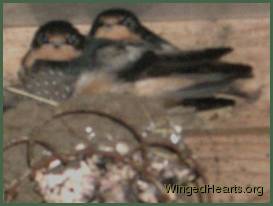
When
tiny little
heads appeared out of the nest, there was a mad scramble for pictures.
But
photographing the
chicks proved to be a much bigger challenge....
I tell you, those little beaks appear to
be quite sharp...there is one nest that a pair are just starting to
build that Maresi noticed which seems kind of late to do. Its
the last little perch in the barn way at the end. Strange I
didn't notice it as that's the way I 'head out' when I go to see my
horse Lavi and
take
the wheelbarrow out for dumping....one of the nests (the one that's
ready to fly) has 5 little ones in it; Lord only knows how they manage
to all squeeze in there.
The parents are quite
protective as I'm sure you know ~ so far I can't tell you how many
times I've (literally) almost been 'smacked in the face' by a
pair of swallows swooping into or out of the barn...I can just picture
me calling in 'sick' to my boss and telling him I had to get stitches
in my face or neck because I was bombarded by barn
swallows!!! yeah sure Claire - right!!!!
|
|
Success
at last
after many balancing acts in hot and humid weather.
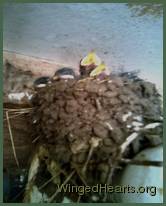
Maresi and
I endeavoured to take some photos of the baby birdies in
their nests with me trying to peek - the only difficulty
we encountered was with Mom Nature in that either the birdies were just
about ready to leave the nest and were facing in the wrong direction
(tail feathers out first) ~ OR ~ they're still too young with
feathers still in the 'pink' and the mom/dad were frantically flying in
and out of the barn and screaming at the top of their lungs; at one
point I really thought they were going to dive-bomb me - there's one
nest that a mom is still sitting on even tho' the fledglings are all
grey, but no eyes open (we can see this by Maresi holding a mirror at
the ceiling and me standing on a step stool)... in addition, I'm NOT the
tallest person, certainly not as tall as Maresi (I'm only about 5' and
she maybe 5'10"), so we have a little 'height problem' here -
Maresi suggested that maybe I could stand on two stall bedding bags so
I'll be in the picture....
Well,
we'll have to try again next weekend!
Thank
goodness for mobile phones with built-in cameras.
|
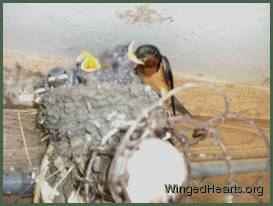 
If you ever saw Maresi trying to
capture a
picture of the baby birds in the nest and waiting for the mama to come
to feed them - Maresi is quite tall and she just had "to stand there" -
hope she didn't get too stiff a neck ...and.. she did get a shot.
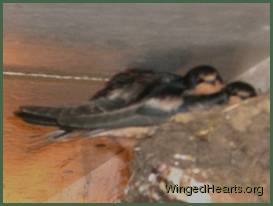
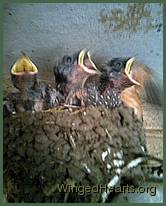
How do
swallows find their chicks in the dark corners of barns?
Mother Nature has it all
sorted out...
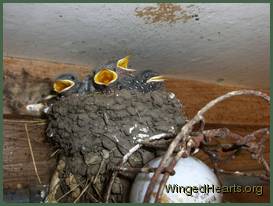
The
little
chicks have bright and shiny yellow mouths that glisten and sparkle
like diamonds, making sure their parents can find them and feed them in
any light as seen in these pictures.
|
|
Claire
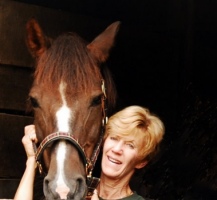
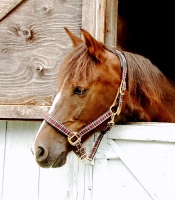
Muskus with her best friend Lavi.
Claire
lives in Lisbon, Connecticut, USA, and dearly loves
watching the golden finches, morning doves, woodpeckers and the
millions (or so it seems) of others.... keeping them safe from the
stray cats whenever she can.
Claire
volunteers at an equine retirement farm - mitchellfarm.org
- a
non-profit organization (check the website - its simply
gorgeous)
and formerly volunteered at Morgan Horse breeding farm.
Thank
you Claire & Maresi for your story & pictures. -- Gitie
& Ron
|
|
|
|
|
|
|
|
|
Back
to the Top |
|
|
Kanga Kisses

Wallaby
kids (joeys) growing up in the Australian bush around our yard know how
to hide in the grass and keep out of human sight. So Ron was
very
fortunate to capture these tender moments of love and care.
Click here for the slideshow
|
|
|
|
|
|
|
|
Back
to the Top |
|
|
Watch Out When you Pick A
Camellia...

There
may be a pair of eyes watching you from the midst of the camellia
petals....
The carpet python is brilliant
at camouflaging itself. Unafraid
of the birds and humans the snake headed straight for the camellia bush
where it took Ron ages to find him. Read more about the encounter
below.
Click
here for the slideshow
|
|
|
|
|
|
|
*****
Advertisement *****
|
Back
to the Top |
|
|
How to Profit from your Expertise
A Special Report and Free Teleseminar
By Kathleen Gage (Bestselling author)
Have you ever read an eReport thinking you were going to find a
solution to a problem only to be extremely disappointed with the
lack of depth in content? Sadly, there are plenty of people trying to make a quick buck by
writing sloppy information products on a topic they think will
make money rather than something they have a passion for.
If you plan to develop information products you will be well
served (as will your readers) to write based on your area of
expertise. A much higher quality of information will unfold
based on your expertise. Answer the following questions to determine what to write on.
What successes have you had that you have the “right” to teach
people about? What are you good at? What do others come to you for advice
about? What topics do you know inside out?
One thing to keep in mind; you have to write subject matter that
potential buyers will be interested in. There’s no reason to
create a report that no one is going to buy. That is why doing
your research before you begin writing is so essential. The beauty of information products is that people rarely buy
just one information product on a particular subject. Think
about your own buying habits. When you have an interest in
something don’t you get as much information as you possibly can
on the topic?
 When I was researching healthy eating I not only bought books
from my local book store, I bought several reports online within
a very short period of time. I wanted as much information as I
could get my hands on. Whether it's animal care, health, midlife, child rearing, or
gardening, most people will buy several resources. Your job is
to identify the market, what keeps them awake at night and
provide a solution by way of a report.
When I was researching healthy eating I not only bought books
from my local book store, I bought several reports online within
a very short period of time. I wanted as much information as I
could get my hands on. Whether it's animal care, health, midlife, child rearing, or
gardening, most people will buy several resources. Your job is
to identify the market, what keeps them awake at night and
provide a solution by way of a report.
Kathleen Gage, The Street Smarts Marketer™, is an Internet
marketing advisor who works with spiritually aware speakers,
authors, coaches and consultants who are ready to turn the
knowledge into money-making products and services. She also owns
horses, dogs, cats and a goat most of which are rescues. Click here for her report on how to develop money making reports.
|
|
|
|
|
*****
Site Highlights *****
|
Back
to the Top |
|
|
|
|
|
|
*****
Coming In The Next Issue *****
|
Back
to the Top |
|
|
News and Views from
WBT
Coming
In The Next Issue:
- Managing Bird Territories
- ....and more...
For Prior Issues visit the Wild Bird Talking Archives
Would you like to submit an
article or your bird story? We would love to
hear these stories and share them with others. Please drop us
a
line at: editor@wingedhearts.org
Invite Your Friends: If you
would like to inform your friends about WingedHearts.org and invite
them to subscribe to the Wild Bird Talking E-zine click
here.
Many Thanks To our Readers: Many thanks
to our friends and readers from around the world
who have visited the site and sent us their comments. We are very
grateful for your support and interest.
Blogs
- Comments: Share your
ideas, opinions and bird friendships by adding comments to the
blogs.
|
|
|
|
|
*****
Subscription *****
|
Back
to the Top |
|
|
Subscription
information:
If you received this message from wingedhearts.org, you are a current
subscriber. To ensure that you continue receiving
our
emails, please add us to your address book or safe list.
If you
received this message from a friend and would like to subscribe at no cost,
please click on the link below and enter details in the left hand menu
bar: http://www.wingedhearts.org
To unsubscribe use the link you received on subscribing or please send
a blank message to subscriptions@wingedhearts.org
with unsubscribe in the subject line.
Share this e-zine with a friend - forward them this e-mail.
|
|
|
|
|
Logo design by Mieke K
All Rights
Reserved. All contents of this e-mail and Ezine are Copyright
2007-2009.
For private, noncommercial use only. Copies must be
unaltered.
Attribution must
prominently state the author's name and that the source of the work is wingedhearts.org |
Back
to the Top |
|
|
|
|
|
|
|
|
|