Dear !fname,

Here is the next issue of Wild Bird Talking Ezine. We hope you enjoy the issue and look forward to your feedback. If you have any trouble viewing the ezine, please contact us at:

    webmaster@wingedhearts.org

With warm wishes
Gitie, Editor


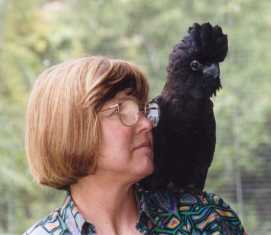
Vicky Feeding Wendy
Wild Bird Talking 
August 2008              WingedHearts.org              ISSN: 1835-6362


Developing understanding and friendship with wild birds


Thank you for subscribing to the
Wild Bird Talking Ezine.  You may forward this Ezine to your friends. If you have received this issue from a friend and would like to receive your no-cost subscription please
click here.


In This Issue:


wbt-logo


*****     Editorial   *****
 
Back to the Top


From Maggie's Perch:~

Welcome to this Edition of  Wild Bird Talking


Winter this year has been the coldest our birds have experienced in many years.  The lilypots have grown in fame and reputation amongst the bird communities with some fascinating spectacles.  Mating time for the galahs and lorikeets usually keeps the birds pretty pre-occupied, but this season the birds made it a point to call out to us and share some of their precious moments with us and fortunately on one of these occasions the camera was ready at hand so we can show you too.

Butch, our pied-butcherbird, developed conjunctivitis in both eyes. The general purpose antibiotic was not helping her this time and the crust had become so thick, she was almost blind.  Disoriented and frightened, her flight was wavering and she could not see the food on the ground.  Under these circumstances the bird normally flies into objects, severely injuring itself, gets attacked by predators or starves to death.  Being a wild bird we didn't know how to catch her.  We thought we'd lost her, but after some calling she appeared and after much coaxing let us catch her.  Cass her mate looked so worried, but we explained what were doing and he settled down.  All the birds could see that Butch needed help and overcame their instincts to let themselves trust us. We wondered if we were doing the right thing, but she did let us catch her, so we took her to the vet.  Glad to say that the prognosis is good. The vet says she is a healthy bird in all other aspects so has a good chance of recovery.  Butch is now in a nice cage in our dinette where her family can see her and she can keep an eye on them too.  The real challenge is to put eye drops in her eyes and then wash them with cotton twice daily as well as give her some natural foods to prevent her getting rickets.  Managing her families till she is able to join them again is also going to be a very interesting adventure.

Best of all was meeting our thornbill friends again.  As tiny as the pardalotes, their big heartedness always commands deep respect. 

This edition features a heart moving story from
Avian Heaven Wild Bird Rehabilitation Centre, a special poem from wildlife artist Janet Flinn honouring one of Australia's iconic birds along with Part 3 of Communicating with Wild Birds.

We hope you enjoy the selection of articles and stories and look forward to hearing your stories.

With Warm Wishes,

From Maggie and me,

Gitie

   Gitie's photo    wbt-logo


wbt-logo


*****     Feature Article   *****
 
Back to the Top


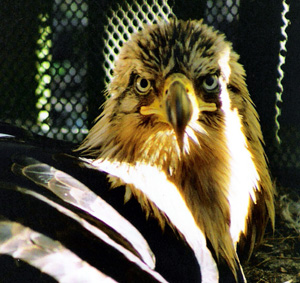
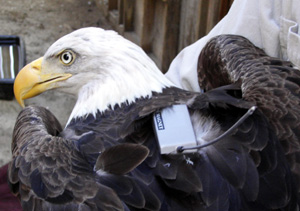
Benedicta in the sun
Photo by Caren Plank

On 9/13/04 we admitted a 4th year bald eagle. She had gone through the windshield of a truck near the town of Benedicta, and had no use of her legs. A physician who happened to bring in an injured heron when we were taking a radiograph offered to take the picture to her radiologist; he thought he saw a "step" in the spine, though the spinal cord appeared to be intact. The wildlife veterinarians at Tufts Cummings School of Veterinary Medicine concurred when they saw it. Within a few days, the bird moved her toes, and by early October, her feet and her legs. The prognosis for complete recovery seemed guarded at best, but everyone we consulted agreed on one thing: spinal injuries require a year or more to heal. We decided to give her that year, assuming that she continued to make progress. We turned one of our songbird cages into a hospital cage for a large bird and made a bed of quilt-covered pillows, where the eagle spent most of her time. The Tufts folks felt that conventional medicine had little if anything to offer, so we decided to explore some alternatives. On 10/5, a friend and colleague Susan, who is also a chiropractor, gave the eagle the first in what would be a long series of chiropractic adjustments. Within a day, the bird stood up for the first time, and after the second treatment a week later, even took a few hesitant "baby steps" before collapsing. By the end of the month, we had moved her and her bed to a larger raptor cage, where she could walk 20-30 feet while flapping her wings for balance, and where the company of two juveniles seemed mutually beneficial. One of our volunteers, Caren, captured this haunting image of her one sunny November day, as late-afternoon light through the slats of the cage walls illuminated her face and shoulders. Several treatments later, we continued to observe the bird standing, walking, and even occasionally perching, though always with a wing-flap assist, and never for more than a few minutes at a time. But despite gaining strength, the eagle remained reluctant to eat; ever since intake, hand-feeding had been necessary. And as December came to a close and the weather turned cold, we felt that she had reached a plateau. With some reluctance, Marc phoned eagle biologists with Maine's Department of Inland Fisheries & Wildlife and the U.S. Fish & Wildlife Service to talk about the possibility of euthanasia.

Benedicta with Tellington Touch

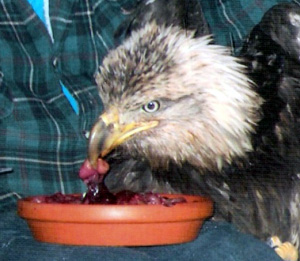
But about this same time, another of our volunteers gave us a book on Tellington Touch (a therapy similar to massage that targets the nervous system). We knew a TTouch practitioner, and on New Year's Day of 2005, Diane called our friend Cheryl to tell her the bird's story. During her years of work at exhibition facilities in other states, Cheryl had worked with many raptors, including eagles, so was familiar with their behavior and anatomy. She came down the next day for an evaluation, and did a joint session with Susan a week later. We saw improvement almost immediately, so Cheryl and Susan decided to alternate weekly treatments thereafter. After Susan finished her next adjustment, the eagle interrupted Marc's hand-feeding to take food from the bowl. Tears came to everyone's eyes as we watched the bird eat on her own for the first time, four months after intake; it felt like a sign that we should continue. By then, we were calling her "Benedicta" rather than "the eagle from Benedicta."

Benedicta eats
Photo by Allan Lord

When the weather turned very cold a couple weeks later, we cleaned out a room off the main infirmary, and made winter quarters for her there. During the treatments, the bird would melt in Marc's arms as Susan or Cheryl worked her magic. Almost with each one, there seemed to be an improvement. Cheryl focused particularly on legs and feet, with the goal of helping her to perch, and by February, she was perching more often that she was lying down. After one of Cheryl's sessions, Benedicta turned around on her perch; after another, she perched on one foot while repeatedly flexing and extending the other leg. She also began to fan and flip her tail. With these signs of healing, we sought and received permission to keep her in rehab beyond the normal 180-day limit. By March, she was beginning to flap her wings as if restless, and when the weather turned warm in April, we moved her back outside. By June, she had two different eagles for company - a nestling from Brunswick (that went to Vermont for reintroduction on 7/9) and an adult from Lewiston (more on her later). At that point, there seemed little hope of release, but we were optimistic about enough recovery for a high-quality life in captivity.

Through the summer, we saw some signs of ongoing improvement, but there were contrary signs as well; she was spending more time than previously on her pillow bed. Early in July, Diane saw her eating a fish she was grasping in her talons, but flapping for balance that she was unable to maintain. By August, despite the continuing treatments, she was lying down most of the time. She had also broken all of her new flight feathers from using her wings for balance and support, and we noticed the first signs of abrasions on her wrists. As summer drew to a close, Susan and Cheryl both felt that Benedicta was failing, and by mid-September, quality of life was on everyone's mind. Once again, Marc made the necessary phone calls. Late on a rainy afternoon a few days later, we went down to the compound to see Benedicta and discovered new sores, this time her elbows. Tears came to our eyes, but no words were necessary. For the last time, Marc gathered her in his arms and carried her to the infirmary. There, almost a year to the day of her injury, we released her bright spirit from its crippled shell. That evening, Susan shared with us a feeling that had come to her during a session in August: that when the effort of holding onto the plateau of function became more than Benedicta could sustain, she would let it go, and trust us to recognize that it was time to let her go.

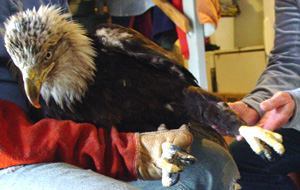
Eagle harnessed
Photo by Bill Hanson

We were somewhat distracted over the next few days, and did not pay close attention to the eagle from Lewiston that had been Benedicta's companion since June. This bird had been spotted on the grounds of a golf course near Lewiston, then chased down by one of Maine's game wardens. When we got her, we could find no injuries or fractures, either by palpation or radiograph. She did have some old, partially-healed wounds on her feet, and was somewhat underweight. But as the weeks went by, she did not fly more than short distances a few feet off the ground, and repeated radiographs revealed nothing, either to our eyes or to those of our mentors at Tufts. In August, while Susan was here to treat Benedicta, she did two chiropractic adjustments on this bird; afterwards, she flew somewhat better, but never to the high perches, and still only for short distances. By fall, we had started to wonder if she would ever recover fully. But then, shortly after Benedicta's death, Marc thought he heard a bird flying high in the raptor compound. One day in October, he entered the flyway and he saw her on a high perch; the next day, she astonished him by flying well over his head. During the month of November, there was dramatic improvement; we saw her fly from the ground to a high perch several times, and she often flew 2-3 laps at a time around the 160' circumference of the flyway. What took her so long to fly remained a mystery; perhaps there was a soft-tissue or nerve injury that simply took a very long time to heal. But the coincidence of her flying so soon after Benedicta's death intrigued us. Had she wanted to remain on the ground with Benedicta? Or was something more mystical involved? In any case, this bird was now more than ready for release.

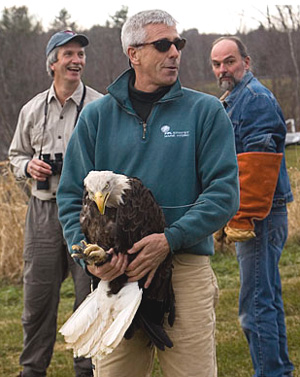
Bill with eagle, Charlie & Marc
Photo by Amy Campbell

As we discussed the situation with various eagle biologists in Maine, an idea emerged. For some time, these biologists had wanted to attach a satellite transmitter to an adult to gather information about their movements, particularly in winter. Gorham-based BioDiversity Research Institute had already done research with transmitters for loons, so this group was brought into the discussion. Our bird was a good candidate: she was already in captivity, so the transmitter's harness could be fitted and evaluated prior to release. The pieces fell into place quickly. A custom-made transmitter was ordered and delivered the day after Thanksgiving. On 11/28, the biologists assembled to fit the harness, which she tolerated just fine. This photo shows the bird at the release site on 12/1. Though several names for the bird were considered (Bill suggested "Gulf Island Girl"), she became more widely known in the group monitoring her whereabouts by the characters on one of her leg bands: "E-70." In the weeks after her release, she meandered south, spending part of that winter in northern Massachusetts. But she returned to Maine in the spring of 2006 and has remained in state since. Telemetry maps have revealed her presence in a number of locales, including the vicinity of her presumed former home near Auburn.

We still cannot tell Benedicta's story with dry eyes; but we feel that she is connected somehow with her companion whose flight recovered so miraculously, and we know that she will always be a part of Avian Haven. She inspired our dream of a habitat designed for orphaned eaglets and injured adults; the completed structure is dedicated to her. And in future days, each time someone reading the plaque asks, "Who's Benedicta?" we will tell her story again.


Avian Haven Wild Bird Rehabilitation Center located in Freedom, Maine is a non-profit wild bird rehabilitation center dedicated to the return of injured and orphaned wild birds of all species to natural roles in the wild. Rehabilitation and repatriation of wildlife is a medical, ecological, geographical, cultural, and educational endeavor. To fulfil these Avian Haven provides  comprehensive medical care with modern equipment, rehabilitation in a simulated natural environment; research for wildlife professionals and also education to the general public and academic institutions.

Diane Winn and Marc Payne, are the founders and managers of Avian Haven with a combined rehabilitation experience with more than twenty thousand birds over more than twenty years. Their annual caseload is typically about 1000 birds from over 100 species.

Avian Haven is not funded by any governmental agencies and provides treatment free of charge to birds' rescuers, but is always grateful for small cash gifts to help cover food and medical costs.  


wbt-logo


*****     Poem   *****
 
Back to the Top


A Patchwork of Magpies

by Janet Flinn


There's a patchwork of Magpies across the land,
striding out
claiming it for their own.

Industrious and curious, parental devotion
sometimes excessive,
it seems to us.
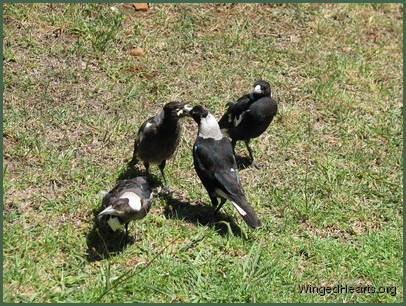
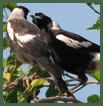
magpies

Magpie stories abound, they've found a place
in our hearts,
we are useful.

Quintessence of Australia, the magpie team
are here and there,
sometimes next-door.

They are Australia's spirit- cheeky, bold, hard-working
not afraid
to take a chance.

In bush and town alike, the caroling of magpies
greets dawn and dusk,
each day.

A delicate melody, ill matched with boldly patterned black and white,
with serious beak
and purposeful claws.

The melody of magpies ripples gently through the sounds of
our lives,
into our hearts.

There's a patchwork of magpies across this land,
their land.
But we are the caretakers.


About the Author:

     Janet Flinn is one of Australia's finest Wildlife Artists. Janet's paintings  reflect the character  of the Australian birds that visit her garden and nearby bushland in Melbourne.  Janet's paintings have received numerous awards including 'Artist of the Year' in 2005.  Her work has been published in many  calendars, magazines, books and reproduced as cards and prints.
To view some of Janet's paintings and contact the artist, click here.
 Janet Flinn


wbt-logo


*****     Feature Article   *****
 
Back to the Top


Communicating With Wild Birds - Part 3

'I Know What You Mean...'

by Gitie House


Love for one's family and friends, calling out to them for meals, chatting with one's siblings, scolding the big bullies, joining forces to chase enemies, making merry at the pool, calling out long and loud then frantically seeking in one spot after another until every members of one's family is safe at home - sounds so familiar.  These are the stuff that makes the ordinary events in a bird's day - much the same as humans.

Realising that a bird's depth of love and consideration is not defined by the size of their physical brain and heart, is key to opening the world of understanding.  The heart knows and the birds begin to feel your empathy intuitively.  (Pet psychologists talk about shared energy as an important way of communicating with one's dog and are now using it to modify their behaviour.) In much the same way, to a bird you now stop being a disinterested external observer or just a kind and benevolent giver (if you've giving them food and water).  You now become someone they can trust, talk to and show their  heart's concerns, a friend.

Understanding With Your Heart

Talking and listening to birds will start becoming a reflex process.  Whenever you hear a bird, if are able, go out and watch what they are doing?  Learn to identify an individual bird by looking for distinguishing features at its feather patterns or shape, size and behaviour.  This will help you recognise the bird from a distance and make it easier to figure out which one is doing what.  A pair of binoculars also comes in handy here.  

Watch their body language change with the different sounds they make.  Tone, pitch, repeating patterns all form part of their language. When do they droop their shoulders, shake their necks, squat, cower, stand tall, fluff up and parade, and so on?  What kind of personalities have they got?  Both the shy and the bold are the easiest to pick.  The fussy one can be spotted too.  But who are the wanderers, the worriers, the lazy, the cheeky, the annoying, the hard-working, the caring and the gossip?

During mating season, the birds will be preoccupied and have less time to socialise with you.  When nestbuilding the mother birds will be very busy and have little time for anything else.  Look around the trees, shrubs in the area and they will show you their nests.   Find out the borders of their territory. How do they tell other birds of their species, which area is being used by them?  Birds whom you may not have yet spoken too, encouraged by your interest will step out of their shells and show you their nests.  It's very exciting and yet deeply humbling, when a bird you had paid no attention to calls you from their nest.  They've been watching you and waiting for an opportunity to connect.  One begins to appreciate the greater web of life and love that exists around us and one's conscious connections with nature deepens. 

When is a young adult being asked to leave home? Which direction are they going? Ask the birds.  You will be surprised at how much they will show you, once they know that you are concerned and can be trusted as a friend.  And suddenly you will discover that they know where their kids are going.  They keep in touch with them through various means.  When you can recognise their individual voices, personalities, favourite hangouts, you will be able to put the pieces together and get to know a lot more about them than you thought possible.

One of my favourite stories is when Larry the butcherbird invited us to his nest (click here to read the story and view the slideshow).  Another favourite is when we rescued a babbler chick, (click here for the full story).

--------


In the next part, we will look at 'Responding To Build Trust', in more detail, as this is the basis for a meaningful communication.  
* * *
You can send your questions on any of these steps to editor@wingedhearts.org and I will do my best to answer them.


wbt-logo


*****     Site Highlights   *****
 
Back to the Top


New Site Spotlights @ WingedHearts.org:


The Lilypots Are Exploding, find out more at
The Sticky Beak,
What does this bird want to show me? - at  Not Just A Bird... for:  
 New additions at Birds I View:    
 Comment on current topics - check out the Blogs:
 You can always view your favourites on:    Feathery Tales, Winged Tips,  Grounded!

Every season brings new activity and the stories are never the same, so keep an eye out for the
new releases with announcements in the blogs.  For info on the photographic equipment we use and featured books/dvds visit:  Resources

Tell us your favourite stories and characters by posting comments in the blog or by sending an e-mail to me at: editor@wingedhearts.org


wbt-logo


*****     Coming In The Next Issue   *****
 
Back to the Top


News and Views from WBT


Coming In The Next Issue:


We are very excited to be able to bring our readers a collection of articles and stories from around the world. The next issue features contributions from:  
  • New stories by bestseller author Brian Taylor
  • Rescuing Birds - Part 2
  • Communicating with Wild Birds - Part 4 - Responding To Build Trust
  • Traditional Enemies or Best Friends? - Surprise items from our Readers


Animal Talk Naturally Radio Interview - 26 August:  Listen to Dr Jeannie and Dr Kim interview us about the birds at 4.30 pm (US-EST) which is 6.30 am on 27 Aug Australian-EST.

Author's Circle Book Releases:

Author and Radio Show Host and January Jones' book "Thou Shalt Not Whine" Amazon campaign will be available to readers on 3 Sep (US time).  The book comes with a huge range of bonuses, including 'From a Wild Bird's Heart Gift Package' which includes the series '23 Amazing Facts About Wild Bird Culture' from WingedHearts.org.

Would you like to submit an article or your bird story?   We would love to hear these stories and share them with others.  Please drop us a line at: editor@wingedhearts.org

Invite Your Friends:  If you would like to inform your friends about WingedHearts.org and invite them to subscribe to the Wild Bird Talking E-zine click here.

Many Thanks To our Readers:  Many thanks to our friends and readers from around the world who have visited the site and sent us their comments. We are very grateful for your support, and interest.
Blogs - Comments: Share your ideas, opinions and bird friendships by adding comments to the blogs.  


wbt-logo


*****     Subscription    *****

Back to the Top


Subscription information:


If you received this message from wingedhearts.org, you are a current subscriber. To ensure that you continue receiving our emails, please add us to your address book or safe list.

If you received this message from a friend and would like to subscribe at no cost, please click on the link below and enter details in the left hand menu bar: http://www.wingedhearts.org

To unsubscribe use the link you received on subscribing or please send a blank message to subscriptions@wingedhearts.org with unsubscribe in the subject line.


Share this e-zine with a friend - forward them this e-mail.


wbt-logo


Logo design by Mieke K
All Rights Reserved.  All contents of this e-mail and Ezine are Copyright 2008.
For private, noncommercial use only.  Copies must be unaltered.
Attribution must prominently state the author's name and that the source of the work is wingedhearts.org
Back to the Top